On April 11, 2026, CoStar Group reports that AI hotel design revives intricate details long lost to modular construction. Architects produce hyper-realistic renders that rival platinum-palladium prints. Iteration times drop 40 percent, CoStar analysts state.
Hospitality firms adopt AI tools at record speed. Statista data shows the global architectural design market hit 52 billion USD in 2025. CoStar projects expansion to 78 billion USD by 2030, driven by AI efficiencies.
AI Hotel Design Tools Boost Precision
Autodesk's generative design suite processes millions of parameters per second. Architects input constraints like light diffusion through filigree screens, subsurface scattering in marble veining, and chiaroscuro contrasts on cornices. The software outputs facades with calibrated negative spaces, proportional symmetries, and tensile curves that echo brutalist precedents.
Gensler applies AI to a Dubai hotel project, announced on April 11, 2026. Parametric models generate filigree screens with interlocking arabesques and cornices echoing Gothic tracery from Viollet-le-Duc. Rendering times fall 35 percent, Gensler confirms.
Photorealistic shadows achieve physical accuracy through ray-tracing algorithms. These visuals evoke William Eggleston's dye-transfer prints from the 1970s, such as 'Greenwood, Mississippi,' where saturated greens and reds define everyday forms. AI renders saturate architectural elements with vivid color relationships and granular textures. Digital contact sheets enable architects to select infinite variations with pinpoint precision.
Visual Storytelling in Hotel Interiors
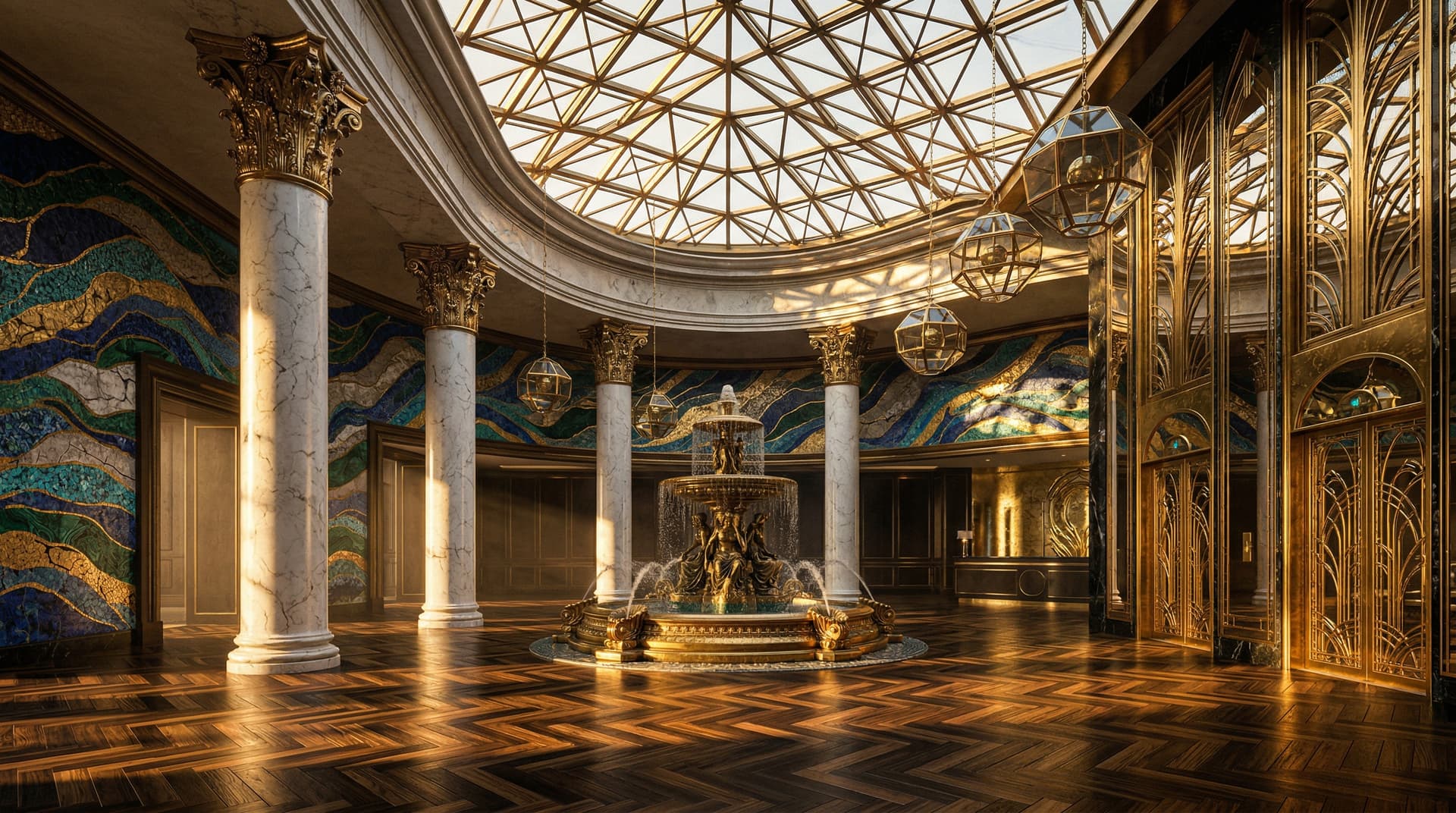
AI simulates marble vein patterns via probabilistic branching algorithms that replicate quarried slab irregularities. Fabric weaves model thread-by-thread interlacing, with luster shifting based on light incidence angles. Luxury hotels specify such details 25 percent more often since January 2026, CoStar notes.
Rockwell Group deploys machine learning for light fixtures that cast modulated glows across tessellated floors. Results mirror analog film's grainy depth, akin to high-resolution sensor captures by Hiroshi Sugimoto. Milan Design Week exhibitions in April 2026 display digital-to-analog print hybrids that blend computational outputs with traditional darkroom techniques.
Immersive spaces function as fine art installations. Precise color relationships, complementary hues in marble and brass, enhance narrative depth and spatial drama. These elements draw from color theory in Josef Albers' interaction studies, creating optical vibrations that guide guest movement.
Hospitality Finance Gains from AI
AI visualization cuts prototyping costs 30 percent. PitchBook reports investors funded proptech AI startups with 4.2 billion USD in Q1 2026, per data from April 11, 2026. Of this total, 1.1 billion USD targeted architectural visualization platforms.
Real estate investment trusts allocate 8 percent of budgets to AI-upgraded properties. Yields rise 4.5 percent, NAREIT data confirms. The hospitality sector rebounds from its 2025 slowdown, with RevPAR growth at 6.2 percent year-over-year.
McKinsey backs CoStar's forecast of 60 percent AI adoption by 2028. Annual savings hit 22 billion USD across the industry. Blockchain provenance tools ensure render authenticity, appealing to institutional buyers.
Case Study: Hilton Singapore Project
Hilton's Singapore flagship employs Midjourney V7 for lobby batik motifs. AI generates pixel-perfect patterns of interlocking parrots and lotuses, scaled seamlessly to wall panels without distortion. Completion schedules for March 2026; prototyping costs drop 28 percent, CoStar confirms.
Guest surveys highlight tactile details in the execution. Thomas Struth's hyper-detailed photographs, like his museum interiors, inspire these outputs and overwhelm viewers with surface resolution. Photo London 2026 galleries showcase AI-hotel hybrids in May 2026.
Construction photos demonstrate render-to-reality fidelity. Subsurface scattering on marble surfaces matches Fujifilm GFX 100 medium-format captures, preserving translucency and depth. Material transitions from brass to stone register subtle patina shifts under ambient light.
AI Elevates Architectural Photography
Photographers resolve micro-textures in AI designs using macro lenses. Leica M11 raw files replicate darkroom grain structures from gelatin silver processes. Les Rencontres d'Arles features these works; curator Clément Chéroux praises their narrative depth on April 11, 2026.
Street photographers frame hotel cantilevers as readymade canvases. They emphasize entasis curves and rusticated bases in compositions that recall Bernd and Hilla Becher's typologies. Arles exhibitions in July 2026 include 25 works blending AI genesis with analog capture processes.
Future Market Projections for AI Hotel Design
CoStar forecasts 60 percent AI adoption in hotel designs by 2028. Chainalysis states stablecoins fund 5 percent of proptech deals, totaling 210 million USD in Q1 2026.
Visual arts evolve through AI lenses trained on archives like Magnum Photos. Paris Photo 2026 panels address generative ethics in November 2026. Architects and photographers collaborate on outputs that merge computational precision with humanist observation. This fusion positions AI hotel design as a new frontier in visual media, with secondary market sales of digital renders projected at 500 million USD annually by 2030.