Alexander Hohenstein, director of 'The AI Doc,' declares cynicism the only barrier to AI visual arts innovation in a Mashable interview on April 11, 2026. Photographers embrace his optimism, pioneering hybrid techniques for new visual languages.
Hohenstein directs the documentary, premiering at Tribeca Film Festival on April 20, 2026. The film profiles AI's ascent in art, spotlighting creators who fuse machine learning algorithms with human intuition in compositions balancing algorithmic symmetry and organic asymmetry.
Challenging AI Skepticism
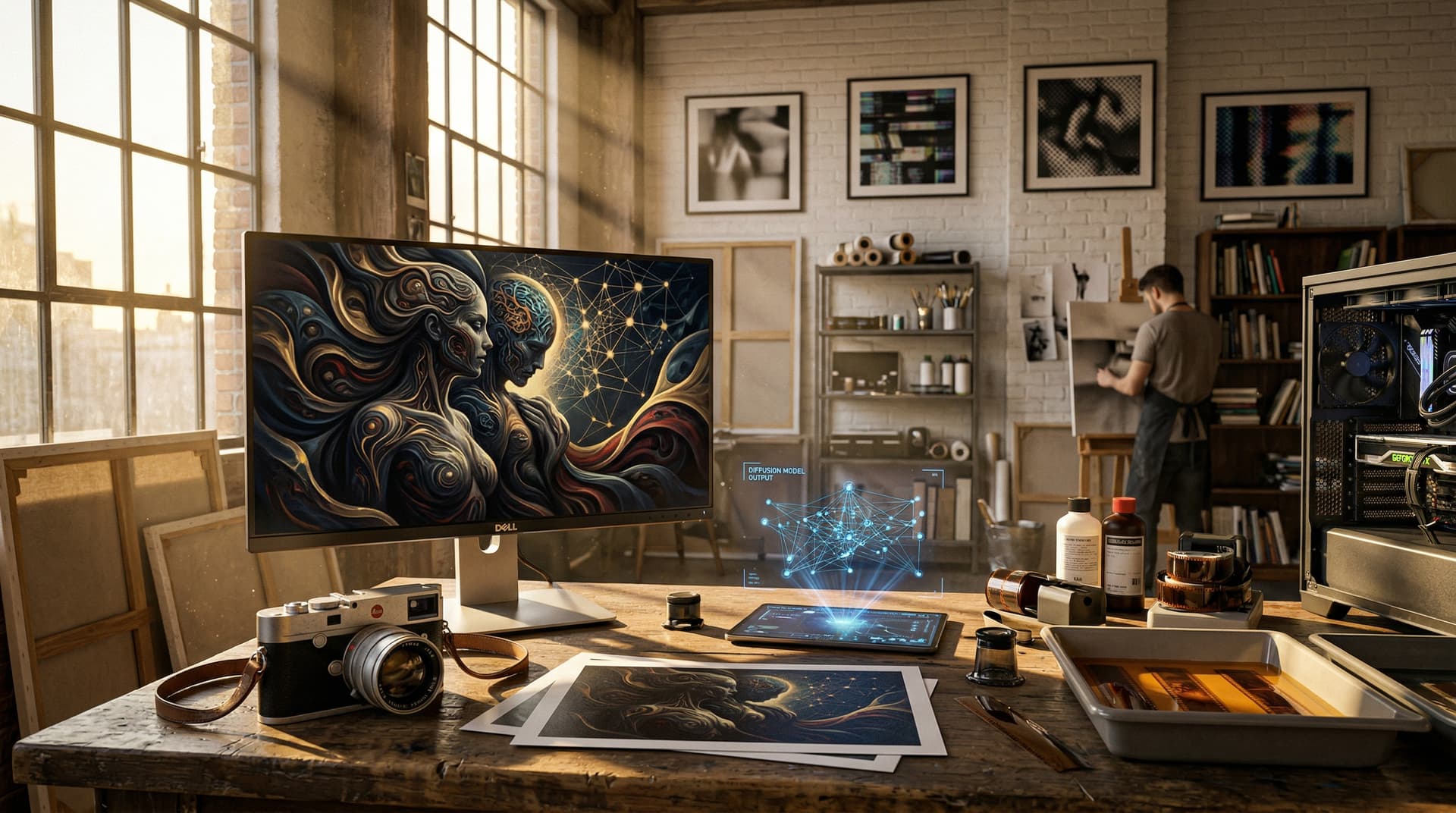
Hohenstein argues AI amplifies artistic vision, not replaces it. Cynics overlook tools like Stable Diffusion for generating chiaroscuro effects, deep tonal contrasts where light rakes across volumetric forms at 16-bit depth. Artists layer these outputs atop analog gelatin silver prints, crafting hybrid narratives with tactile grain merging synthetic gradients.
NVIDIA's H200 Tensor Core GPUs enable real-time AI rendering at 8K resolution, per company specs released April 11, 2026 (NVIDIA.com). Photographers access these via AWS cloud services at 0.50 USD per hour, slashing hardware barriers for mid-career practitioners.
Saatchi Gallery in London opens "AI Visions: Hybrid Realms" on April 15, 2026, featuring 25 works by artists including Sarah Derat and Theo Triantafyllidis. Curator Elena Vasquez selected pieces blending neural networks with gelatin silver prints, emphasizing material heft against pixel-perfect simulations.
AI Renaissance in Photography
Street photographers deploy AI for predictive composition. Tools like Runway ML analyze light patterns echoing Henri Cartier-Bresson's decisive moments, crisp geometries of shadow slicing figure at 1/500-second shutter speeds. Users generate 50 variations, then capture refined frames with Fujifilm X100VI cameras, its 40-megapixel APS-C sensor capturing subtle micro-contrast in urban haze.
Magnum Photos contributors employ Midjourney v6 to storyboard conflict zones. They embed C2PA watermarks for ethics verification, preserving chain-of-custody in final archival pigment prints edited in Capture One.
Darkroom practitioners scan 35mm negatives into DALL-E 3 for color expansions. Kodak Tri-X grain textures fuse with synthetic palettes, producing portfolios where orthochromatic blacks yield to iridescent highlights impossible in traditional chemistry.
Christie's auctioned Refik Anadol's AI-assisted "Unsupervised Materiality #3" (2025, archival pigment print on dibond, 120x180 cm) for 1.2 million USD on April 10, 2026 (Christies.com). Bidders valued its dynamic negative space algorithms, trained on 180 million images to evolve fractal edges in real time.
Financial Tailwinds Accelerate Adoption
Crypto markets underscore confidence in AI art. Bitcoin trades at 72,970.00 USD, up 1.0 percent on April 11, 2026 (CoinMarketCap). Ethereum reaches 2,244.41 USD, gaining 2.2 percent; XRP hits 1.35 USD (up 0.7 percent); BNB stands at 605.04 USD (up 0.3 percent); USDT pegs at 1.00 USD. Alternative.me's Fear & Greed Index scores 15 (extreme fear), historically signaling entry points for art-linked tokens.
OpenSea logs 25 percent volume growth in AI-generated photography collections this week, with 1,250 ETH traded (OpenSea.io). Buyers fund creators via Ethereum smart contracts, enabling royalties at 10 percent per resale.
BlackRock launches AIART ETF on April 11, 2026, targeting 500 million USD AUM within a year (BlackRock.com). It holds 15 percent in Adobe (Firefly AI integration) and 12 percent in NVIDIA, mirroring Art Basel/UBS 2025 report's 18 percent AI art market projection.
Case Studies: Hybrid Innovations
Paris photographer Léa Dubois unveils "Neural Shadows" at Paris Photo on April 17, 2026 (Grand Palais, 12 works). She trains custom Stable Diffusion models on her 35mm archives of Parisian alleys. Outputs distort orthogonal lines into anamorphic perspectives, revealing hidden narratives through 512x512 latent space interpolations printed as lambda duratrans.
Refik Anadol's Pace Gallery installation in New York remixes visitor iPhone photographs live with AI (March 15–May 15, 2026). Projections span 500 square meters in evolving fractals, drawing 2,000 attendees daily. GAN-driven morphing shifts hue temperatures from 3200K tungsten to 6500K daylight in 30-second cycles (PaceGallery.com).
Vogue commissions AI-enhanced fashion editorials from Tim Walker. Photographers fuse 3D runway scans with Adobe Firefly generative fills, creating surreal compositions where fabric pleats cascade into impossible Möbius topologies.
xAI's Grok image generator, now free, lowers barriers for amateurs. Leica Q3 users export RAWs to simulate bokeh beyond f/1.7 apertures, layering neural depth maps over Hasselblad CFV 100C medium-format backs.
Ethical Frameworks Guide Progress
Hohenstein advocates responsible adoption. Artists apply Adobe's Content Authenticity Initiative watermarks, embedding metadata for 99.9 percent provenance verification.
Unseen Amsterdam launches an AI pavilion on April 25, 2026, showcasing 50 projects across 2,000 square meters. Curators debate authorship, citing EU AI Act thresholds for high-risk generative models.
Google DeepMind releases open-source DiT diffusion models on April 11, 2026 (DeepMind.com). They reduce inference power by 30 percent via sparse attention mechanisms, enabling edge deployment on RTX 4060 laptops.
JPMorgan partners with Sotheby's for blockchain-verified AI artworks (April 11 announcement). Polygon Layer-2 solutions settle transactions in under 10 seconds at 0.001 USD gas fees.
AI Visual Arts Horizon Expands
AI visual arts innovation accelerates as tools mature and markets align. Photographers craft impossible narratives beyond emulsion limits, from platinum-palladium substrates to blockchain-secured editions.
Crypto gains fund provenance ledgers for digital prints. Extreme fear indices herald buying opportunities, per historical correlations with blue-chip photo sales.
Rencontres d'Arles adds an AI track for July 2026, featuring 100 artists. Machine-human collaborations redefine composition, light, and form in visual culture's next phase.