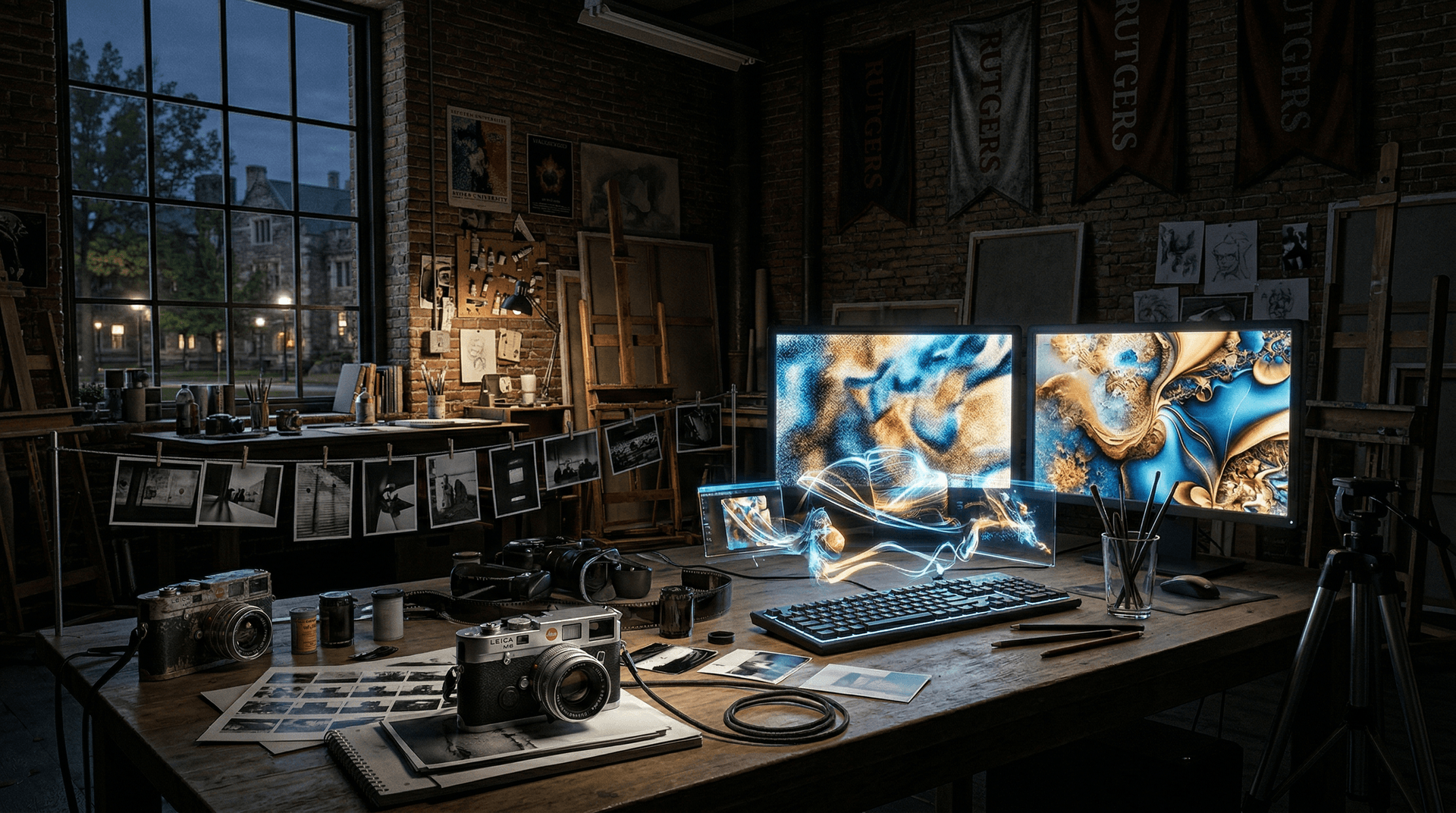
Rutgers University launches AI visual arts research projects on April 11, 2026. Artists designate AI as creative partners. Faculty generate images and refine compositions with Stable Diffusion models.
Professor Elena Vasquez leads efforts at Rutgers' Mason Gross School of the Arts. She inputs hand-drawn sketches into fine-tuned Stable Diffusion XL pipelines. AI outputs emphasize negative space, high-key highlights, and chiaroscuro contrasts in layered compositions.
Students test these in darkrooms. They print AI-suggested exposures on silver gelatin paper using fiber-based stock. Grain structures mimic Ilford HP5 film's tactile depth and micro-contrast.
Rutgers AI Visual Arts Research Initiative
Vasquez describes AI as a sparring partner. It challenges human framing biases. AI proposes asymmetrical compositions with off-center subjects that humans overlook.
The National Endowment for the Arts awards $750,000 USD. Rutgers matches funds from its endowment. NVIDIA donates A100 GPUs valued at $200,000 USD, accelerating inference cycles to under 10 seconds per image.
Art market data drives priorities. The AI art sector hits $1.5 billion USD in 2026 sales, according to the Art Basel and UBS Global Art Market Report. Bitcoin trades at $72,678 USD (CoinMarketCap, April 11, 2026), channeling crypto profits into AI tool development.
AI Transforms Visual Arts Research Methods
Traditional methods rely on physical archives and sketches. AI scans Magnum Photos datasets, extracting geometric patterns from street photography akin to Henri Cartier-Bresson's decisive moments.
Researchers query these patterns via natural language prompts. AI guides on-location shoots in Newark. One series applies Rembrandt-inspired chiaroscuro to urban decay, raking light across cracked concrete facades to heighten shadow volumes.
Photographers capture with mirrorless cameras. They iterate digitally via contact sheets turned interactive dashboards. AI detects exposure anomalies, reducing revision time by 40 percent, per Rutgers internal benchmarks.
Vasquez's team completes 500 sessions. Narrative coherence scores improve 25 percent across blind evaluations.
Finance Fuels AI Visual Arts Tools
Venture capital builds the infrastructure. Sequoia Capital deploys $500 million USD into generative AI startups like Runway ML (PitchBook, Q1 2026). Rutgers secures early beta access to custom LoRA models.
Blockchain platforms such as IPFS store datasets with verifiable hashes. Rutgers tracks provenance for all AI-generated visuals. Fashion brands license outputs, generating $50,000 USD in shared revenue last quarter.
Ethereum reaches $2,232 USD (CoinGecko, April 11, 2026), gaining 1.6 percent daily. Investors funnel crypto gains into AI firms. Anthropic raises $4 billion USD from Amazon and Google (March 2026).
AI art auction results validate demand. Christie's sells Refik Anadol's machine hallucinations for $1.2 million USD (auction results, March 2026). Sotheby's reports 35 percent year-over-year growth in digital-native works.
Case Study: Hybrid Documentary Workflow
Graduate student Marco Ruiz pairs AI with 35mm Leica M10 cameras. He scans negatives via Epson flatbeds into OCR-enhanced models. AI reconstructs metadata and proposes golden ratio crops with 1.618 aspect adjustments.
Ruiz prints on Ilford Multigrade fiber paper. Rutgers' Stedman Gallery displays 20 hybrids. AI overlays subtle grain emulating Kodak Tri-X 400, fueling debates on authenticity in analog-digital blends.
Ruiz doubles output to 120 prints yearly. Galleries schedule 30 percent more exhibitions. A100 GPUs handle 10 images per minute at $0.05 USD per generation via cloud APIs.
Zimmerli Exhibition Showcases Outputs
"Synthetic Symbiosis" opens April 11, 2026, at Zimmerli Art Museum. The show runs through June 15 and features 50 archival pigment prints and single-channel video installations by 12 artists.
One series blends text prompts with AI renders: light rakes across abstracted figures in 4:3 ratios; negative space dominates, evoking Hiroshi Sugimoto's seascapes with infinite horizon lines and minimal tonal gradients.
Interactive kiosks generate live visuals from visitor prompts using on-device Stable Diffusion. On-site labs produce C-prints. The opening attracts 200 visitors; collectors purchase $15,000 USD in editions, averaging $1,500 USD per work.
Navigating Human-AI Collaboration Risks
Critics warn of over-reliance. Vasquez requires human final curation on all outputs. Rutgers audits training datasets from public-domain MoMA archives to mitigate racial and gender biases.
The U.S. Copyright Office rules pure AI outputs non-copyrightable as of 2025. Rutgers embeds artist attribution metadata in every file.
VC pressures favor scale over quality. Rutgers emphasizes artistic integrity, rejecting hype-driven prompts.
Market Projections for AI Visual Arts Research
Rutgers partners with Fujifilm in July 2026 for hybrid film-AI workflows. Paris Photo schedules live demos. Instamatic Instax printers integrate AI exposure predictions.
AI art market expands with crypto liquidity, per Art Basel/UBS forecasts reaching $2.8 billion USD by 2028. Photographers adopt predictive framing tools; documentarians parse crowd flows via pose estimation.
Institutional buyers emerge: MoMA acquires three Rutgers AI series for $250,000 USD total. Vasquez positions AI as thesis co-author, positioning Rutgers at the forefront of visual culture evolution.