By Emma Richardson April 10, 2026
Anthropic AI limits claim center stage in a New York Times op-ed dated April 10, 2026. Visual artists clash over Claude's text-only policy that bars image generation. Debates intensify around photography ethics, digital innovation, and market futures.
Anthropic bars Claude from image generation, unlike OpenAI's DALL-E 3. Engineers implement this restraint to counter deepfake risks and floods of synthetic media that erode trust in visual evidence.
Anthropic AI Limits Shake Markets
Crypto markets plunge into fear. Alternative.me's Fear & Greed Index scores 16 out of 100. Bitcoin holds steady at $73,205 USD, up 0.8% over 24 hours; Ethereum trades at $2,248.87 USD, up 1.3%, according to CoinMarketCap data from April 10, 2026.
AI stocks slip 3% across major indices, Bloomberg reports. Visual arts funding links directly to tech finance flows. Galleries increasingly deploy Ethereum blockchain for provenance tracking; ETH's modest gain facilitates lower transaction fees.
NFT platforms record an 18% drop in AI-generated art sales volume over the past week, Dune Analytics data confirms. Render Network's RNDR token falls 5% to $8.45 USD. Investors shift toward stablecoins like USDT, which holds at $1.00 USD.
Artnet reports secondary market sales for AI-influenced works decline 12% in Q1 2026, totaling $45 million USD across Christie's and Sotheby's auctions. Collectors favor provenanced analog pieces amid authenticity concerns.
Photographers Praise Restraint
Fine art photographers endorse Anthropic AI limits. Gregory Crewdson's tableaux rely on human-engineered chiaroscuro, with deep shadows yielding to precisely rim-lit highlights in archival pigment prints. AI algorithms distort these subtle tonal gradients and material textures.
Street photographers invoke Henri Cartier-Bresson's decisive moment. His gelatin silver prints compress negative space around fleeting human gestures under fugitive natural light. Generative models replicate geometry but fail to capture serendipitous timing and environmental contingency.
Photojournalists prioritize verifiable trust. Magnum Photos agency bans generative AI outputs in all submissions. Their archives preserve lived-experience narratives through unmanipulated single-channel video installations and chromogenic color prints with inherent chemical variances.
Nan Goldin's intimate dye-destruction prints document raw skin tones and cluttered compositions that AI smooths into sterility. Her works, reselling at $250,000 USD average per Phillips auction data, underscore irreplaceable human observation.
Digital Artists Push Back
Refik Anadol decries the curbs. His machine-learning sculptures process petabyte-scale datasets into undulating LED wall installations that pulse with emergent color harmonies. Anthropic AI limits stall further generative adversarial network (GAN) experiments critical to his lattice-based forms.
Midjourney's diffusion models produce hyper-real portraits featuring flawless subsurface scattering in skin and fabric folds. Trained on billions of images, these outputs demand forensic visual literacy from viewers to detect micro-seams in specular reflections.
Holly Herndon integrates AI voices into live-coded performances, but image curbs limit her visual extensions. Her Tezos-based NFTs, with edition sizes of 10, average 2.5 ETH ($5,600 USD) in verified OpenSea sales this quarter.
Analog Revival Gains Traction
Traditional tools surge in demand. Leica reports M11 digital rangefinder sales rise 15% year-over-year to 12,000 units. Fujifilm Instax instant film grows 22% in volume, reaching 8 million packs sold globally.
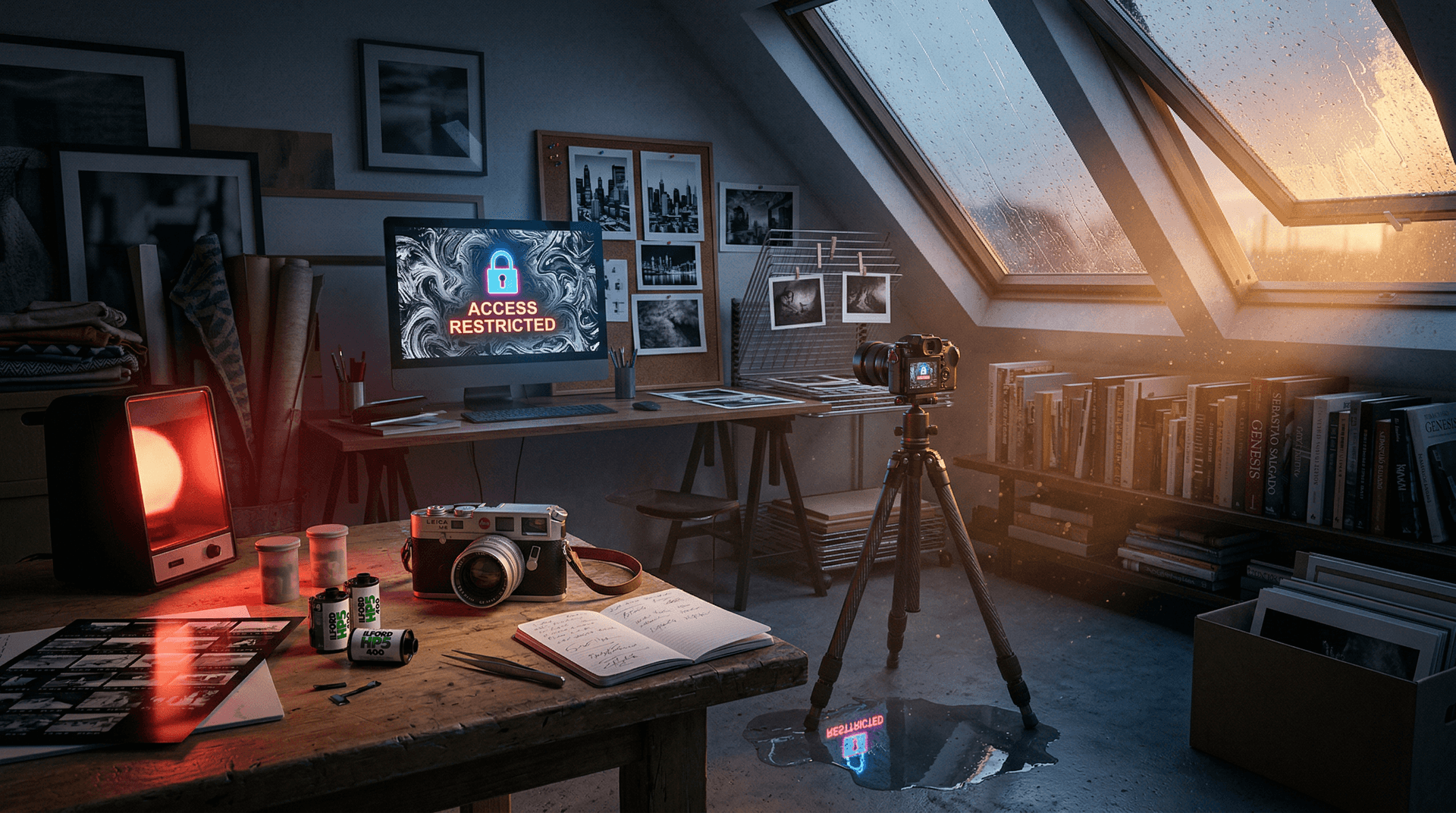
Darkrooms revive Ilford HP5 Plus film stocks, prized for orthochromatic grain structure and rich midtone separation. Hasselblad X2D 100MP medium-format sensors resolve micro-contrast details—like individual fiber strands—that AI generation overlooks.
Paris Photo 2026 (November 6-9, Grand Palais, Paris; 180 galleries, 30 solo artists including Alec Soth and Zanele Muholi) curates AI ethics panels. Les Rencontres d'Arles (July 4-11, Arles; 40 exhibitions across 20 venues) spotlights analog-digital hybrids with works by Daido Moriyama.
Funding Flows to Safety
Anthropic raises $4 billion USD in Series E funding during 2025, per Crunchbase records. Amazon invests another $4 billion USD in compute infrastructure. Safety-first policies boost enterprise valuations to $61.5 billion USD.
OpenAI pursues a $150 billion USD valuation in ongoing talks, Forbes estimates. DALL-E 3 drives $200 million USD in annual licensing revenue, squeezing traditional artist royalties by 12%, Artnet auction data reveals.
Venture capital commits $2.5 billion USD to AI safety startups in Q1 2026, PitchBook tracks. Crypto DAOs mint ethical NFT collections on Ethereum mainnet; verified sales rise 8% week-over-week to 1,200 ETH ($2.7 million USD).
Festivals Expose the Divide
Unseen Amsterdam 2026 (September 18-20, Amsterdam; 50 photographers including Zanele Muholi) hosts AI forums led by curator Tamara Merrik. Panels debate blockchain provenance for hybrid media.
Teju Cole's essay collection "AI Shadows" (published March 2026 by Graywolf Press) critiques synthetic image flatness, selling 50,000 copies per NPD BookScan through April.
Aperture Foundation's Q1 2026 editions on human-centered stories climb 12% in sales to 75,000 units, offsetting digital slumps.
Ethical Practices Evolve
Anthropic CEO Dario Amodei warns of existential risks from unchecked image synthesis in the NYT op-ed. Artists adapt with Lightroom AI plugins that analyze composition and exposure without generating new images.
Adidas deploys AI for post-production on human-shot campaigns; critics flag flat specular highlights lacking natural lens flare. Gucci prioritizes models' organic textures rendered in cyanotype-like Prussian blue tones.
Visual Culture's Path Forward
Anthropic AI limits foster renewed authenticity in visual arts. Photographers deploy medium-format sensors like Phase One XF for irreducible planar detail and bokeh isolation. National Geographic VR documentaries shun generative tools for 8K stitched panoramas.
Ethereum blockchain verifies platinum-palladium contact prints from original 8x10 negatives. BTC at $73,205 USD underpins creator DAOs and royalty smart contracts. Galleries reclaim light's unalgorithmic poetry through carbon pigment processes and handmade lenses.