Anthropic AI restraint dominates a New York Times opinion piece on April 10, 2026. Executives Dario and Daniela Amodei warn of societal risks from unchecked generative tools. Visual artists debate photography ethics and digital markets.
NYT Op-Ed Drives Art World Caution
Amodei siblings detail internal safety protocols delaying AI releases. Their approach contrasts OpenAI's rapid scaling. Anthropic prioritizes alignment research over speed, citing potential misuse in creative fields.
Galleries report surging AI-generated submissions. Curators at Paris Photo 2026 mandate transparency labels on all works, specifying training datasets and generation parameters. Ethical guidelines gain traction across major exhibitions.
Artnet data shows a 17% rise in flagged AI submissions to blue-chip galleries since Q1 2026.
Generative Tools Reshape Photography
Midjourney and DALL-E generate photorealistic images in seconds. These tools disrupt traditional composition, decisive-moment capture, and Leica lens optics like the Noctilux's characteristic bokeh balls.
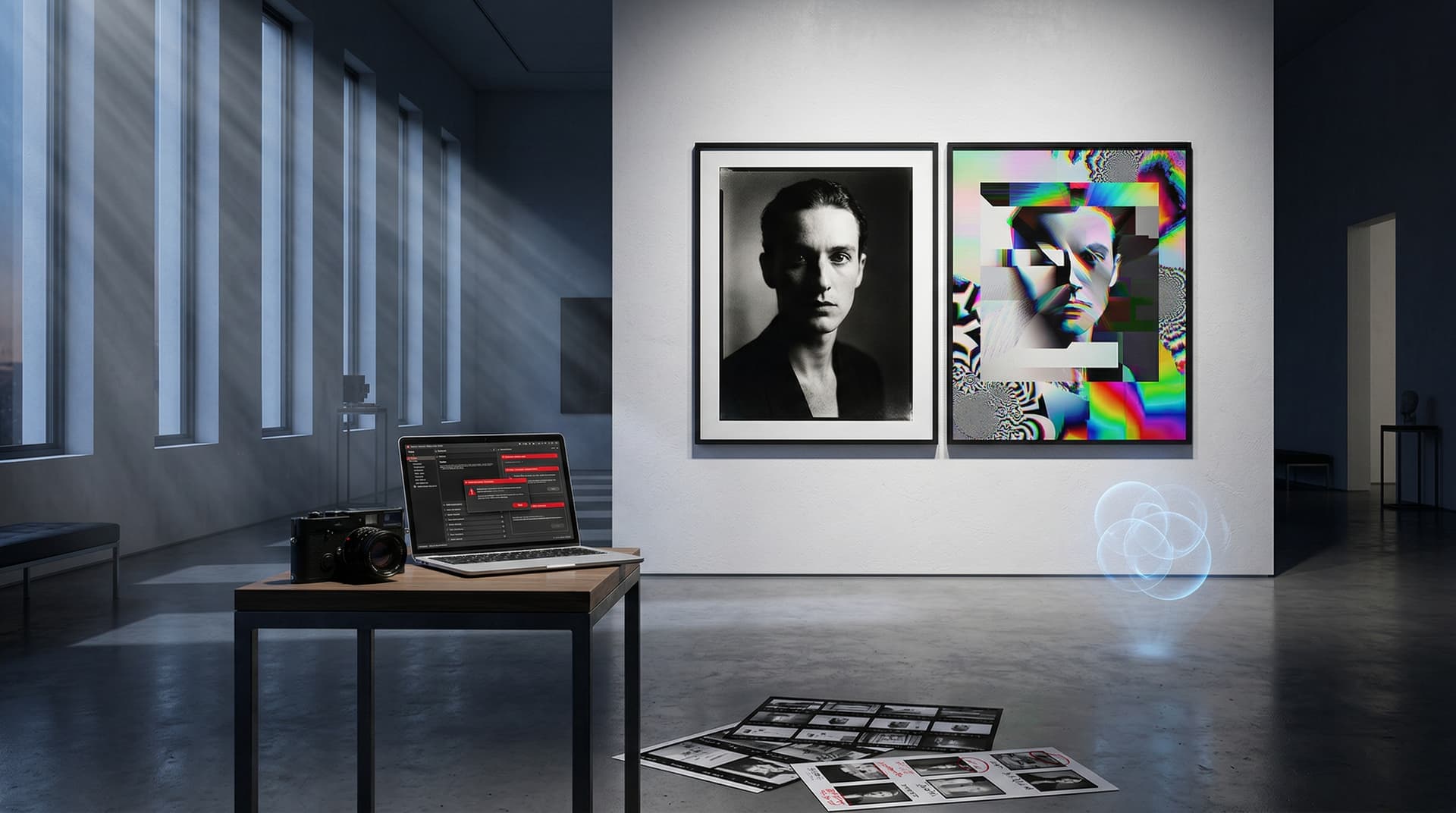
Magnum Photos members layer analog film's silver halide grain atop AI-driven chiaroscuro contrasts. Yet AI often fails to replicate subsurface scattering in human skin tones or the micro-contrast of platinum-palladium prints.
Anthropic flags deepfake risks to documentary veracity, where synthetic shadows lack coherent light source geometry.
Visual Arts Association survey on April 10, 2026, shows 62% of photographers fear job losses. AI automates negative space calibration and golden ratio framing. Authorship questions escalate amid provenance challenges.
Anthropic AI Restraint Hits Art Markets
NFT platforms record $45 million USD in AI art sales for Q1 2026, per NonFungible.com data. Investors retreat from volatile projects post-op-ed, with OpenSea AI-tagged volumes dropping 23%.
Sequoia Capital cuts AI art fund allocations by 15%, TechCrunch reports on April 10, 2026. Funds pivot to blockchain provenance for analog photography, boosting platforms like Verisart.
Venture capital slows for generative startups. Imagen.ai raises $20 million USD in seed funding for compliance-focused tools with embedded watermarking. Art Basel/UBS report notes investor shift to verified human works.
Exhibitions Draw Human-AI Lines
Unseen Amsterdam 2026, October 15-18, restricts entries to human-created works across 50 galleries. AI fabricates hyper-real urban scenes with improbable light falloff and inconsistent atmospheric perspective, eroding authenticity.
Fine art advocates reference Hiroshi Sugimoto's gelatin silver prints. His seascapes deploy subtle horizon-line gradients and infinite-focus depth via large-format optics that AI approximations distort through unnatural edge halation.
Darkroom equipment sales climb. Fujifilm Instax volumes increase 28% year-over-year, per company filings on April 10, 2026, resisting digital saturation. C-41 chemistry demand rises 12%.
Curators Mandate AI Disclosure
Tate Modern announces policy on April 10, 2026, requiring generative tool provenance for all submissions. Foam Gallery's "Synthetic Visions" exhibition spans April 15 to June 30, 2026, in Amsterdam, featuring 25 archival pigment prints and single-channel video installations.
Curator Julian Germain selects works probing AI in photojournalism. Each labels specific generative processes, training datasets from LAION-5B, and human intervention levels.
Adobe Firefly implements safeguards, pausing features amid Anthropic influence. Fashion photographers adopt hybrid visuals, blending AI compositing with medium-format film scans for restrained enhancement.
Finance Tracks Broader Shifts
AI equities decline post-op-ed. Anthropic's valuation drops 2.1% to $61.5 billion USD, Bloomberg reports on April 10, 2026.
Nasdaq falls 1.8%, Yahoo Finance data confirms. Nvidia faces margin pressure from slowed AI rollouts, with stock dipping 3.4%.
Render Network utilization drops 12%, per dashboard metrics. Investors prioritize verifiable art technologies, funneling $150 million USD into provenance startups per PitchBook.
Future Regulations Reshape Visual Arts
EU proposes AI art regulations by Q3 2026, mandating disclosure for gallery sales over €10,000. Rencontres d'Arles 2026 panels on July 7 explore restraint, with Nan Goldin addressing authenticity in dye-transfer prints.
Publishers like Taschen decline pure AI photobooks. They require contact sheets evidencing human exposure choices, film development, and dodging/burning notes.
Hybrid practices proliferate. Artists embed AI outputs beneath analog chromogenic prints, retaining tactile material presence, gelatin emulsion texture, and narrative intent grounded in human observation.
Anthropic AI restraint refocuses visual arts on human perceptual acuity. Markets favor transparent, provenance-tracked works. Capital targets enduring innovations in analog and blockchain-verified media.