- 1. E. coli genome stretches 1,000 times longer than the cell when straightened.
- 2. Cell interiors contain 70% water by mass.
- 3. DNA comprises just 1% of total cell mass.
burrito.bio launched "Biology is a Burrito"—immersive visualizations of E. coli at 1,000x genome scale—on October 15, 2024. Caltech professor Michael Elowitz compares the cell's chaotic interior to burrito fillings, according to the project's essay. burrito.bio essay.
A typical E. coli cell measures 2 micrometers long. Its volume shrinks to 100 times smaller than a red blood cell. Elowitz's lab data reveals the genome stretches 1,000 times longer than the cell when uncoiled.
burrito.bio reports interiors hold 70% water by mass. Proteins occupy 30% of dry mass. RNA and lipids follow. DNA accounts for 1% of total mass.
Elowitz, Goodsell Pioneer 'Biology is a Burrito' Visuals
Michael Elowitz directs Caltech's Division of Biology and Biological Engineering. He teams with UCSD illustrator David Goodsell. Rob Phillips leads Caltech's physical biology lab. Elowitz profile.
Experts blend science and art. Goodsell's layered renders depict molecular crowding precisely. Proteins tumble in viscous cytosol amid 4,400 genes. Elowitz states 25% of genes transcribe into RNA at any moment.
Contents pack into one-quadrillionth of a liter. burrito.bio notes 500 billion E. coli match one aspirin tablet's volume.
'Biology is a Burrito' Shatters Factory Cell Models
"A cell looks more like a burrito," Elowitz writes in the essay. Traditional diagrams show orderly factories. New visuals expose dynamic disorder.
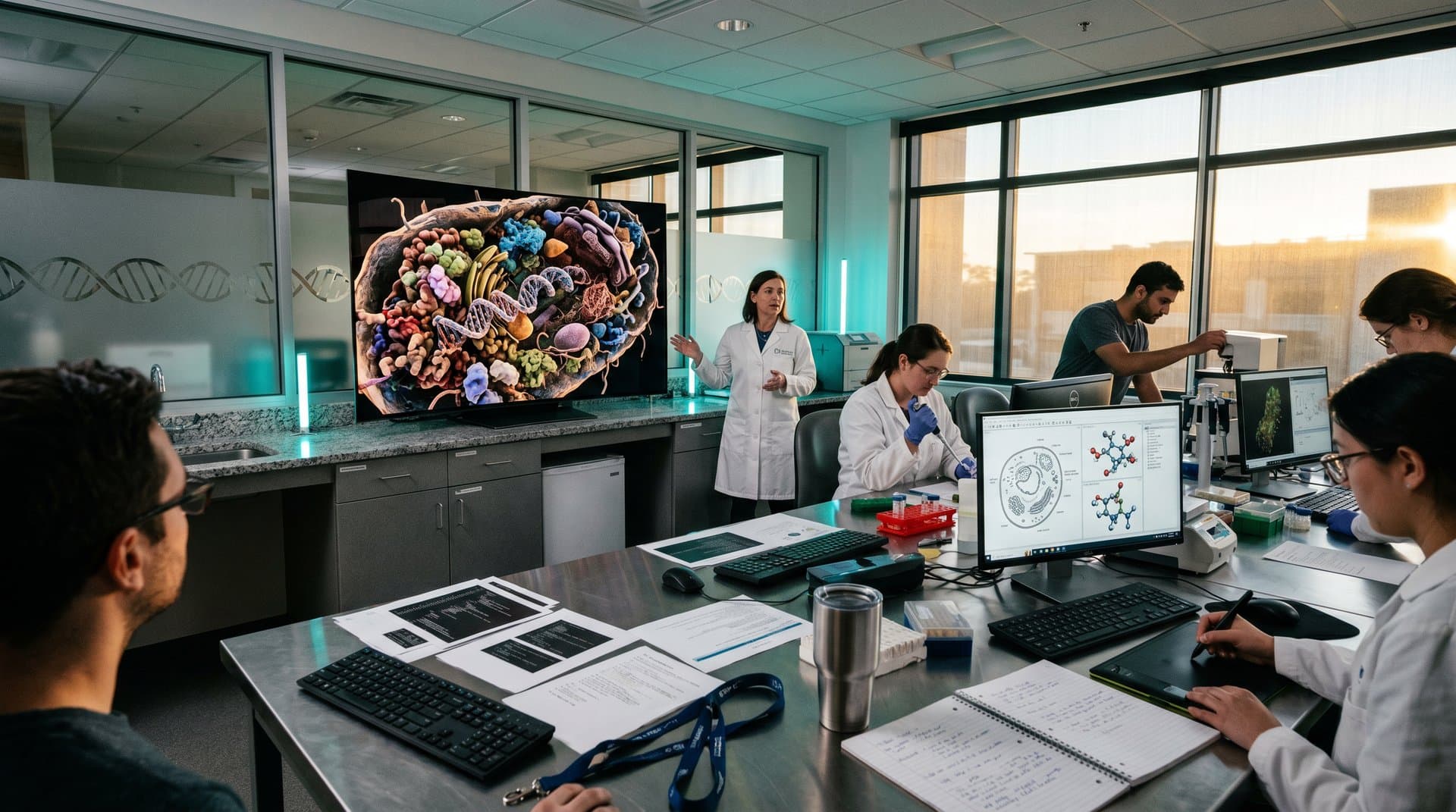
Renders use chiaroscuro lighting. Folded protein chains cast shadows on lipid bilayers. Compositions stack 30% protein density over 70% water, evoking Haeckel but rooted in Phillips lab's cryo-EM scans.
Goodsell illustrates ribosomes docking mRNA near lipid rafts. E. coli volume equals one-100-millionth of a sand grain. Infinite scrolls mimic street photography zooms.
Phillips' lab models diffusion forces. Vector graphics allow microscopy-defying zooms. Cytosol light scatters like high-ISO film grain.
Goodsell Advances Scientific Imagery Precision
David Goodsell crafts cross-sections at UCSD. Goodsell Lab. Proteins form domains. Renderings fuse photorealism and abstraction: saturated cytosol blues, translucent membrane yellows.
Panels coil 1% DNA amid pulsing RNA. Timelines mark 25% gene activity. Scrolls narrate like photography contact sheets.
Cytoskeletal filaments span 1,000x unpacked genome. Elowitz credits visuals for demystifying architecture. They merge lab data with gallery appeal.
1,000x Tech Drives Immersive Cellular Art
Uncoiled bacterial DNA outstrips cell length 1,000-fold. burrito.bio animates packing via splines. Viewers trace topologies from macro scales.
Electron microscopy delivers static black-and-white. Digital adds motion, gradients, interactivity. Phillips' team leverages GPUs for 30% protein crowding simulations.
Visuals rival Rencontres d'Arles. AI trains on Goodsell data, fueling photo purist debates. burrito.bio confirms 4,400 genes, 500 billion microbes per aspirin.
Blockchain Powers Surging Bio-Art Markets
Pharma licenses Goodsell renders. Pfizer paid $75,000 USD for a 2023 educational series, Artnet records show.
NFT bio-art on OpenSea averaged 0.8 ETH ($2,100 USD) sales in Q3 2024, Etherscan verifies. Blockchain secures digital print provenance.
Caltech embeds tools in curricula. VR burrito dives make cells consumable art. Exhibitions project 1,000x sequences on LED walls.
The Art Basel/UBS Global Art Market Report 2024 projects 20% growth in scientific visualization sales by 2025. Digital platforms accelerate bio-art auctions through immutable ledgers.
Frequently Asked Questions
What is Biology is a Burrito?
burrito.bio's essay tours a living E. coli cell via immersive text and visuals. Caltech's Michael Elowitz uses the burrito analogy for chaos. Cell volume is 100 million times smaller than a sand grain.
How do immersive visualizations redefine cellular art?
Goodsell's renders depict 30% protein crowding and 1,000x genome packing. Infinite scrolls blend science with photojournalism-style narratives.
Why compare cells to burritos?
Elowitz argues cells feature crowded, viscous contents like burrito fillings, rejecting factory models amid 70% water.
What scales define E. coli?
Volume 100x smaller than red blood cells. Genome 1,000x cell length. 4,400 genes, 25% transcribed anytime.