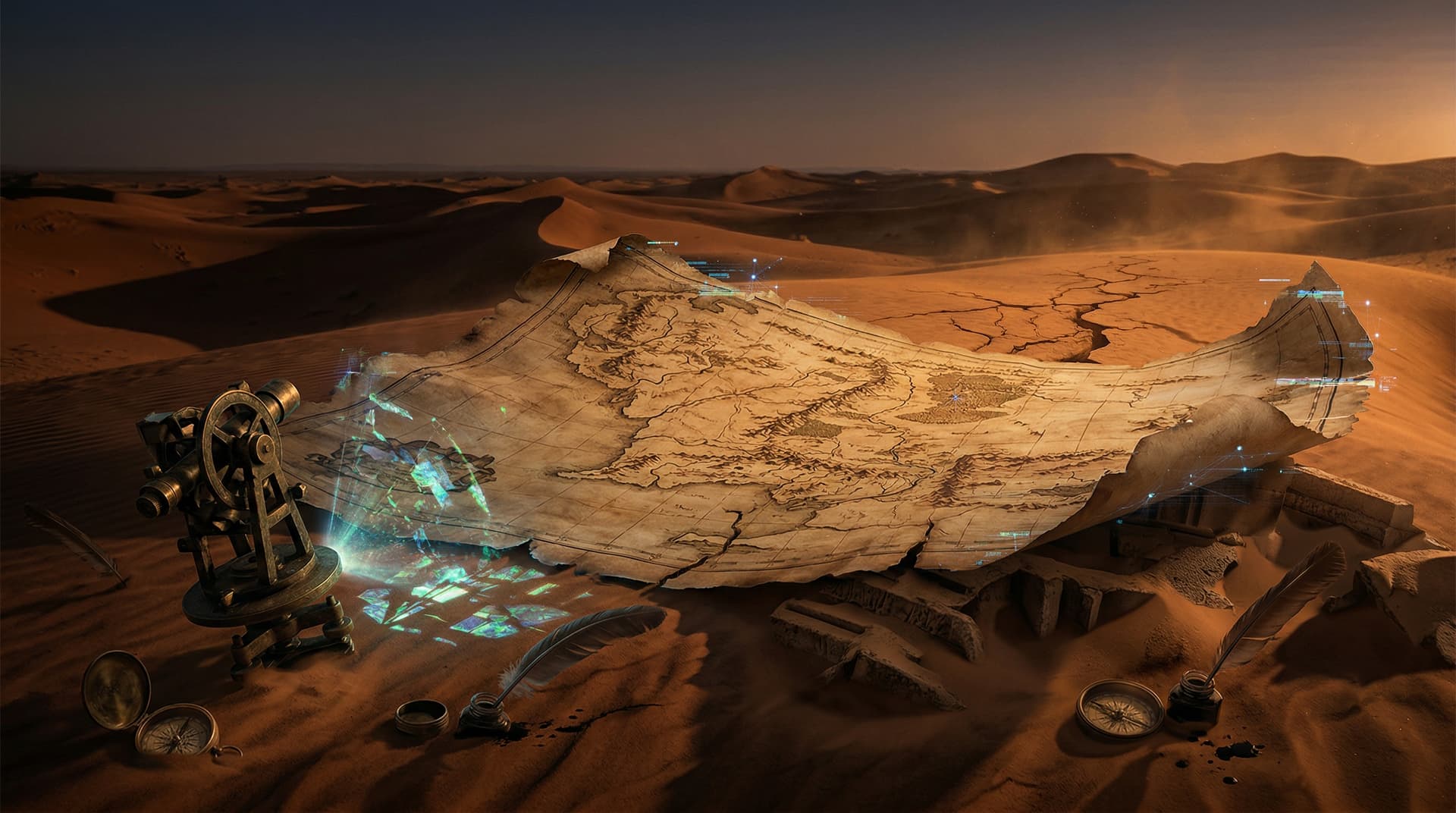
On April 11, 2026, visual artists applied the Borges cartographers AI parable to decode hyper-detailed large model outputs. Borges' 1946 story "On Exactitude in Science" depicts a 1:1 map that crumbles into ruins. Creators sift AI images in photography and digital art for signal amid excess.
Borges narrates empire cartographers crafting a 1:1 scale map. It overlays every grain of sand and blade of grass yet proves unusable, crumbling into desert ruins. Contemporary AI tools like Midjourney v7 and Stable Diffusion XL replicate this overload, spawning thousands of hyper-real variants from single prompts.
Large models produce outputs mimicking archival pigment prints or single-channel video frames. Artists specify formal elements such as chiaroscuro contrasts, golden-hour rim lighting on metallic surfaces, or disrupted leading lines in urban decay. Human tacit visual literacy separates resonant compositions from mere data dumps.
Borges Cartographers AI Parable Parallels
Photographers comb AI contact sheets for echoes of Henri Cartier-Bresson's decisive moment, where geometry and gesture converge. Refik Anadol's machine hallucinations at Serpentine Galleries (London, 2025) fused petabyte-scale datasets into billowing forms. Organic color gradients and pulsating light pulses emerged only through Anadol's curation, blending AI volume with human narrative arcs.
Michael Polanyi's tacit knowledge framework explains this edge. Artists intuitively detect negative space rhythms, subtle color dissonances, or material textures absent in raw generations. AI dominates syntax but falters on semantic depth and emotional cadence.
NFT platforms track this shift via blockchain. OpenSea data shows AI-tagged NFTs surging 20% in Q1 2026 volume (DappRadar). Floor prices hold at 0.5 ETH ($1,129 USD, ETH at $2,258, CoinMarketCap April 11). Top sales, like Beeple's latent space collages, hit 5 ETH ($11,290 USD), rewarding curatorial rigor.
Decoding Large Model Outputs with Precision
Artists iterate prompts akin to darkroom dodging and burning. One refines: "abandoned factory interior, golden-hour light piercing shattered windows, high-contrast grain on rusted beams, leading lines disrupted by foreground debris." Outputs approximate Gregory Crewdson's twilight tableaux, his signature cool blue tones and suspended tension, but often flatten cultural subtexts like labor history echoes.
Visura magazine contributors benchmark Midjourney v7 against street photography canons. Simulations nail candid gestures in platinum-palladium tonalities, with deep blacks and crisp highlights. Human edits restore contextual layers, such as geopolitical markers or social rhythms.
Paris Photo organizers announced an AI ethics panel for November 2026 (Grand Palais, Paris, 30+ speakers). They cited Borges' parable on April 11 to frame interpretation over raw generation.
Finance Fuels AI Visual Art Ecosystem
AI art startups secured $450 million USD in Q1 2026 funding (CB Insights). Runway ML raised $308 million USD for video gen tools; Stability AI added $100 million USD for diffusion models. Investors favor creators triaging outputs amid Render Network's RNDR token at $4.20 USD (up 1.1%, CoinGecko April 11).
OpenAI's GPT-5o visual inference runs $0.05 per 1,000 tokens (API pricing, March 2026 update). Visual artists craft efficient prompts under 100 tokens to slash costs, treating generation as a capital expense.
Foundation.app enforces 2.5% creator royalties on editions. Tacit curation drives secondary premiums, even as Crypto Fear & Greed Index lingers at 15 (Extreme Fear, Alternative.me April 11).
Practical Lessons from Borges Cartographers AI
Creators triage 90% of outputs for formal failures: broken golden ratios, anatomical distortions, or incoherent depth of field (per Midjourney Discord analytics, Q1 2026). Unseen Amsterdam 2026 (FOAM, May 15-June 30, 50 works) dissects DALL-E 4 sequences for emergent themes.
Magnum Photos' Alex Majoli integrates AI into conflict zone composites. He filters hyper-real facsimiles through Leica M11 film grain, restoring tactile authenticity and shadow modulation.
Tate Modern requires human annotations for AI acquisitions (policy update, March 2026). Curators invoke Borges' ruined map to demand interpretive layers beyond pixel perfection.
Visual Culture's Hybrid Frontier
BNB Chain AI art DAOs pool BNB ($607.53 USD, up 0.3%, CoinMarketCap) for communal prompt libraries. Collective human vetting curbs stylistic homogenization, fostering diverse material simulations.
Analog film revivals pair with Foam Talent 2026 (Amsterdam, 20 emerging artists). Juries prioritize hybrid works blending AI scale with darkroom tactility: precise emulsion irregularities over uniform gradients.
BlackRock's iShares AI Innovation ETF climbs 15% YTD (Morningstar, April 11, 2026). It invests in human-AI symbiosis platforms like Adobe Firefly integrations.
The Borges cartographers AI parable endures as a compass. Visual artists navigate digital map ruins, reclaiming chiaroscuro drama, material heft, and interpretive fire.