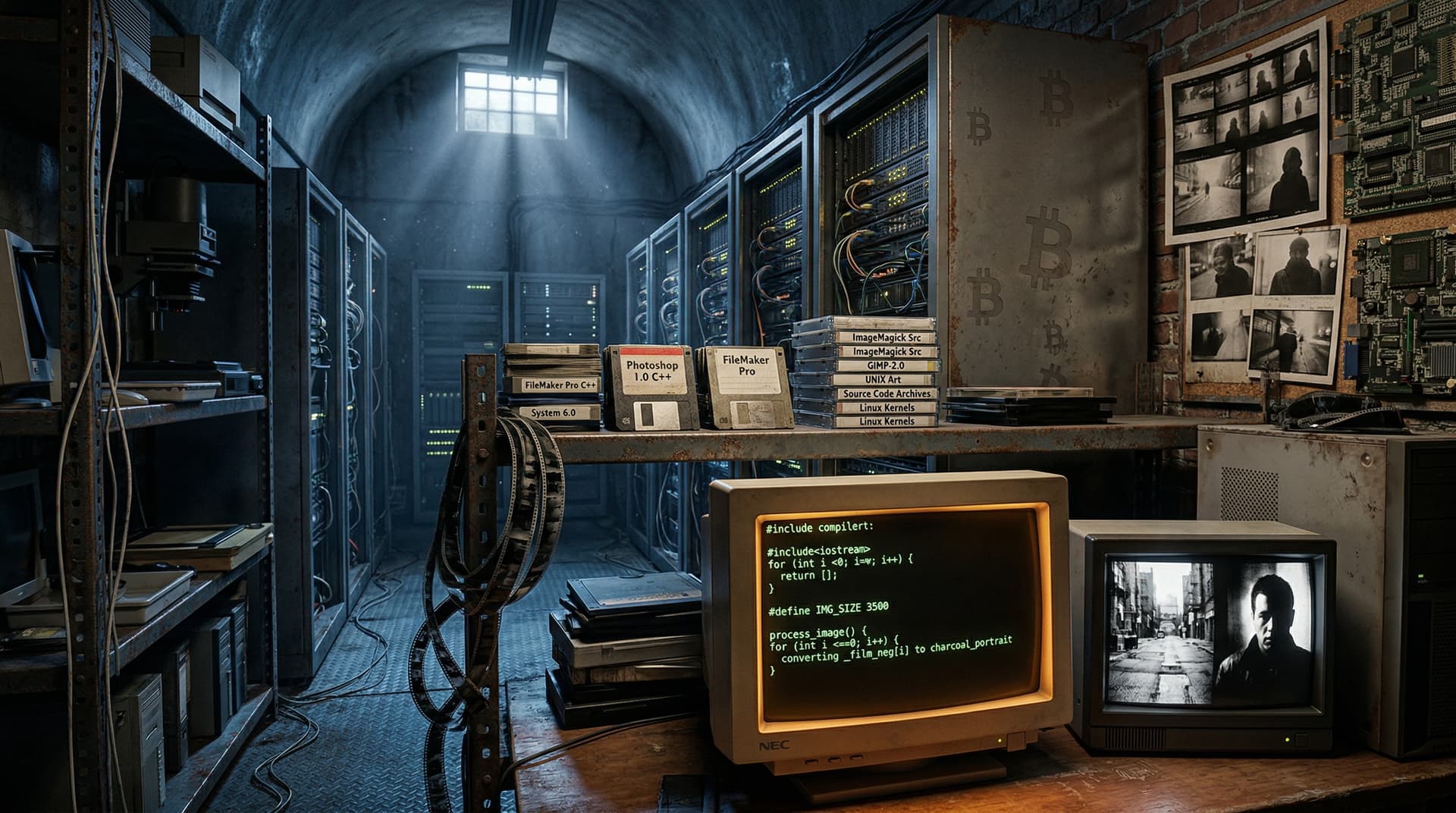
Software Preservation Group launched the C++ History Collection on April 12, 2026. This archive safeguards 450,000 lines of C++ source code from 1990s-2010s digital darkroom software. Developers relied on C++ for high-performance tasks like layer compositing and histogram adjustments that propelled photography from analog film to pixel-based workflows.
Group director Elena Vasquez revealed the collection at a virtual event. C++ dominated because it handled memory-intensive image processing with speed unmatched by contemporaries.
Inside the C++ History Collection
Adobe Photoshop 1.0 (1990) leveraged C++ for multilayer compositing. It supported precise opacity masks and duotone conversions with 8-bit channel precision. Thomas Ruff used these tools for his deadpan portraits, dissecting identity through flattened color fields and cropped compositions that evoked Bernd and Hilla Becher's typologies. Ruff's digital prints sold for $512,000 USD at Christie's New York, March 2025 (Artnet).
ImageMagick's C++ library enabled batch conversions, geometric transforms, and convolution filters. Artists scripted grain emulation to mimic Kodak Portra 400's fine halide structure. The archive includes version 5.4.7 source code from 2005, as Vasquez confirmed. These routines powered early NFT provenance tools for digital scans at Paris Photo 2023.
GIMP (1996) implemented its clone tool in C++ for seamless pixel retouching. Street photographers corrected lens distortions on portable laptops, achieving barrel correction via polynomial models. Version 2.0 code reveals optimized heap management for large canvases.
Darktable (2009) used C++ modules to decode raw Bayer filter patterns. Documentary photographers edited non-destructive workflows in the field, applying lens profiles with sub-pixel accuracy.
Visual Transformations Driven by C++
C++ powered algorithmic skin tone mapping in fashion photography. Mario Testino deployed Photoshop C++ plugins for selective color boosts, enhancing editorial vibrancy while preserving midtone contrasts. Testino's digital works commanded $1.2 million USD total at Sotheby's London, 2024 (Artnet).
Hugin panorama stitcher relied on C++ SIFT feature detection algorithms. Photographers merged bracketed exposures into HDR composites, controlling dynamic range from 8EV to 14EV. The archive holds 2010.0.0 source code, emulatable on modern ARM processors.
Contemporary AI tools like Stable Diffusion build on C++ tensor operations from these libraries. Film revivalists dissect grain shaders for generative models. Paris Photo 2026 will feature preserved tools in dedicated digital preservation pavilions.
Preservation Funding and Market Dynamics
The group solicits Bitcoin donations amid market volatility. BTC traded at $71,643 USD on April 12, 2026, down 1.6% daily (CoinMarketCap). ETH hit $2,215 USD, down 0.9%.
Annual server costs reach 500,000 USD. Donations rose 12% year-over-year per group records. Crypto Fear & Greed Index registered 16, signaling extreme fear (Alternative.me).
Ethereum smart contracts verify code integrity. IPFS ensures decentralized replication. Bitcoin Lightning sidechains log commits at 0.001 BTC (71 USD) per transaction.
Preservation startups attracted 10 million USD in Q1 2026 venture capital (PitchBook). Key investors include a16z Crypto and Paradigm. Tate Modern schedules C++ code exhibits for 2027, tying into its digital acquisition budget of 15 million GBP (museum reports).
Artnet reports digital tool emulations boosted NFT photography sales 18% in Q1 2026, with floor prices for generative film-emulation editions averaging 0.5 ETH.
Challenges and Future Roadmap
Emulators execute legacy C++ on x86-64 and ARM hardware via LLVM backends. Bit rot threatens 20% of archived files (Digital Preservation Coalition, 2025 report).
EU Digital Europe grants allocate 250,000 EUR annually for server infrastructure. Legal barriers limit proprietary code releases; open-source dominates. Leica contributed 2000s SDKs under fair-use provisions.
Rencontres d'Arles curators request live demos for 2027 programming. A web-based emulator launches June 2026, powered by WebAssembly. Workshops will teach C++ implementations of light falloff curves and chromatic aberration fixes for emerging artists.
Rust-based collections launch next. The C++ History Collection secures visual media's digital lineage, informing blockchain provenance for tomorrow's 1 billion USD AI art market (Art Basel/UBS Report, 2026 forecast).