Sales of generative AI art reached $450 million USD globally in 2025. Art Basel and UBS released this data in their Global Art Market Report on April 10, 2026. Sales increased 35% from 2024.
Photographers integrate AI models like Stable Diffusion 3 and DALL-E 4 into workflows. These tools generate surreal composites from text prompts. Traditional techniques hybridize with diffusion-based outputs.
Generative AI Art's Historical Roots
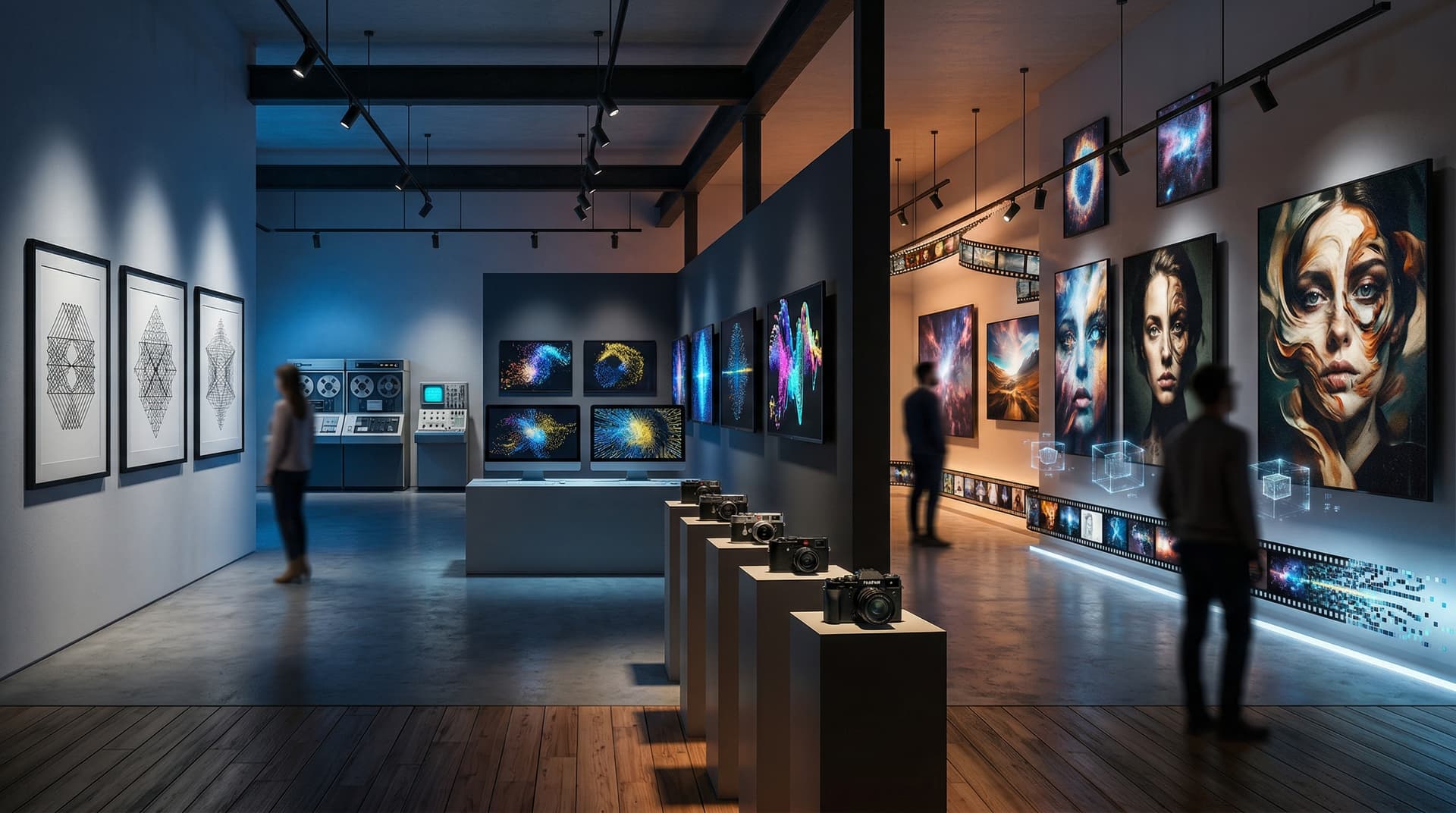
Generative art originated in the 1960s. Georg Nees exhibited algorithmic drawings at the Stuttgart Institute of Technology in 1965. Plotters traced probabilistic black lines on white paper, forming rhythmic geometric lattices.
A. Michael Noll created works at Bell Labs that same year. His algorithm mimicked Willem de Kooning's brushstrokes with jagged digital paths. Viewers questioned machine authorship.
Frieder Nake programmed Fortran for plotter outputs. Vera Molnar systematically varied ellipses and grids. These emphasized algorithmic process over static product.
Digital Tools Expand Generative Systems
Manfred Mohr projected four-dimensional hypercubes into black-and-white line grids during the 1970s. His works dissected cubic volumes into orthogonal projections.
Harold Cohen launched AARON in 1973. The software autonomously rendered colored forms and figures until Cohen's death in 2016.
Casey Reas and Ben Fry released Processing in 2001. Artists coded particle flows and cellular automata, producing dynamic screens of emergent patterns.
Harm van den Dorpel sold early generative NFTs on Ethereum in 2014. Blockchain ensured provenance for mutable digital editions.
GANs Fuel Generative AI Boom
Ian Goodfellow invented Generative Adversarial Networks (GANs) in 2014. A generator creates images; a discriminator critiques realism. Nvidia's StyleGAN refined photorealistic faces in 2018.
OpenAI debuted DALL-E in 2021. Text prompts yielded chimeric objects, like rubber ducks in Van Gogh skies. Midjourney gained millions on Discord.
Stability AI open-sourced Stable Diffusion in 2022. Artists trained custom models locally. Runway ML enabled text-to-video by 2023.
Christie's sold an AI portrait for $432,500 USD in 2018. Pak's Merge NFT collection generated $91.8 million USD on Sotheby's in 2021.
AI Reshapes Photography Techniques
Photographers layer AI outputs onto analog scans. Sara Barnes composites Midjourney-generated ethereal figures atop film captures of rusted metal, blending synthetic glow with organic grain.
Refik Anadol projects machine hallucinations at SFMOMA's Latitude 37 installation in 2025. Vast urban datasets morph into undulating light fields, drawing 200,000 visitors.
AI simulates chiaroscuro with precise light falloff gradients. Latent vectors produce negative space akin to darkroom vignettes. Justine Bell-Metereau iterates prompt histories, questioning editorial authenticity.
Contact sheets become slider logs. Decisive moments fuse with probabilistic generations.
Art Market Finance Backs AI Ecosystem
Stability AI raised $101 million USD in 2022. Adobe's Firefly integrates into Photoshop for $20 USD monthly. Sotheby's digital sales reached $15 million USD in March 2026.
OpenSea reported 25% NFT volume growth in Q1 2026. The Crypto Fear & Greed Index hit 16 on April 10, 2026, signaling investor caution amid Bitcoin at $72,574 USD.
Investors view generative AI art as a volatility hedge. Blockchain royalties on XRP and BNB support creator earnings.
2026 Exhibitions Highlight Hybrids
Paris Photo 2026 (November 6-9, Grand Palais, Paris) features 50 galleries. Curator Simon Baker spotlights hybrid photo-AI works with 200 exhibitors total.
Rencontres d'Arles opens July 1, 2026 (through September 26). Martin Parr curates "Algorithms in the Field," showcasing 15 documentary projects with real-time generation.
Unseen Amsterdam (September 2026) presents Hack-P collective. They code live visuals from street cameras across 10 works, sparking data ethics debates.
Leica M11 users pair sensors with iPad models. Fujifilm X100VI feeds fuel custom trainings.
Generative AI Art Blurs Visual Boundaries
Gucci employs AI for runway composites. Vogue editorials merge neural architectures with silver gelatin prints.
Reuters tests generative fills in photojournalism. 2026 ethics codes mandate disclosure labels.
AI noise emulates Tri-X film's silver halide texture. Todd Hido endorses targeted applications.
Adidas campaigns generate athlete portraits. Deloitte's 2026 Creative Tech Report notes 40% cost reductions.
Future Outlook for Generative AI Art
Google's Imagen Video 2 renders 10-second clips instantly. Nvidia RTX 5090 GPUs cost $1,999 USD.
IBM previews quantum generative simulations for 2027. Scarcity proofs may elevate prices.
Ethereum upgrades cut smart contract fees for editions. Artists use open-source tools.
Generative AI art augments photography. Human vision thrives in this synthesis.