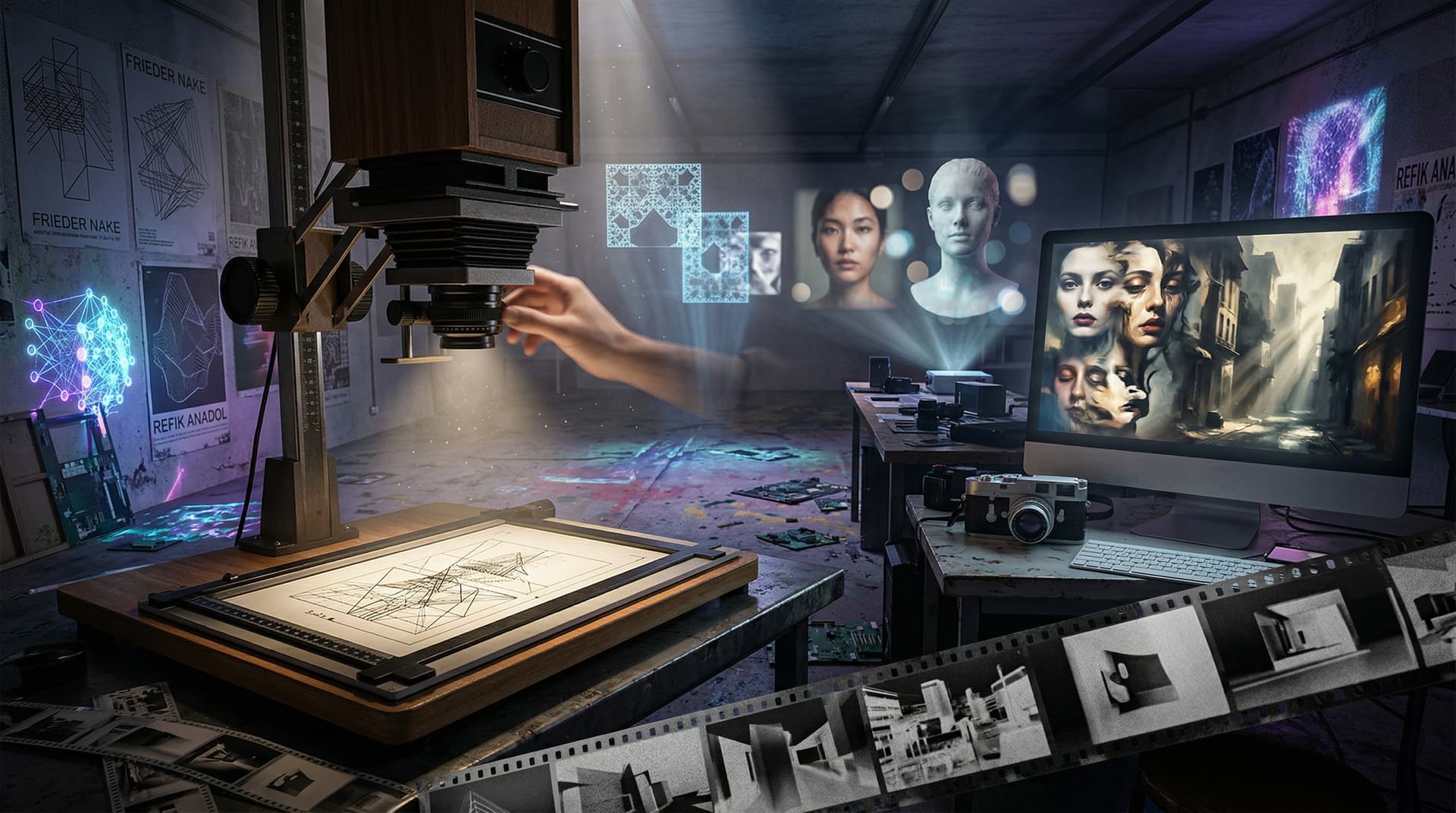
Generative AI evolution reshapes photography and visual arts on April 10, 2026. Neural diffusion models account for 45% of new gallery submissions, per Christie's annual report. This shift drives a 28% rise in digital art sales.
Photographers integrate these tools to craft decisive moments once captured only by chance. Prompts yield traditional chiaroscuro with precise light falloff and shadow gradients. Visual artists accelerate iteration cycles to deepen narrative depth in portfolios.
Algorithmic Foundations in the 1960s
Frieder Nake pioneered generative art in 1965 with plotter drawings at Stuttgart University. Computers followed strict rules to produce geometric abstractions. Code-defined parameters emphasized negative space.
Georg Nees exhibited similar works that year. Viewers witnessed machine logic reveal patterns invisible to human eyes. Early systems lacked neural complexity but established procedural creation precedents.
Developers prioritized mathematics over aesthetics. Outputs echoed concrete art movements. Museums like the Victoria and Albert archive these as foundational digital artifacts.
GANs Spark Generative AI Evolution
Ian Goodfellow introduced Generative Adversarial Networks in 2014 at the University of Montreal. One neural net generated images; another critiqued them. This rivalry yielded realistic faces by 2017.
Nvidia researchers advanced StyleGAN in 2018. The model separated facial features into editable layers. Photographers used it to prototype portraits with unnatural symmetries.
GAN art sales surged. Robbie Barrat's 2018 portrait fetched 400 ETH ($130,000 USD), per Obvious collective records. GANs bridged fine art and computation.
Diffusion Models Redefine 2020s Creation
Stability AI released open-source Stable Diffusion in 2022. Users prompted text for photorealistic scenes. Midjourney offered Discord-based tools emphasizing artistic styles.
OpenAI's DALL-E 3 handled complex compositions by 2024. It simulated Tri-X film grain pushed to ISO 1600. Photographers layered these with analog overlays.
Flux.2 from Black Forest Labs leads 2026 benchmarks. It generates 4K scenes with accurate depth of field. Professionals adopt it at 62%, per Adobe's Creative Trends survey.
Photography's Hybrid Renaissance
Street photographers reconstruct missed decisive moments. Tools inpaint crowds or adjust golden hour light. Refik Anadol's 2025 Tate Modern installation merged AI outputs with archival scans.
Documentary workflows evolve. AI simulates contact sheets from sparse inputs. Magnum Photos members test ethical previsualization.
Fashion brands like Gucci prototype mood boards in seconds. Costs drop 35%, per McKinsey's 2026 media report. Outputs match Helmut Newton's high-contrast glamour.
Crypto Markets Fuel Generative Art Boom
Blockchain platforms like Art Blocks minted 1.2 million generative pieces since 2020. Code generates unique variations.
On April 10, 2026, Crypto Fear & Greed Index hits 16 (Extreme Fear), per Alternative.me. Bitcoin trades at $72,962 USD (up 1.4%). Ethereum holds $2,242.32 USD (up 1.5%).
NFT sales continue. XRP reaches $1.35 USD amid USDT stability at $1.00 USD. BNB trades at $606.89 USD. SuperRare logs $42 million USD in generative art last quarter.
Commercial and Ethical Shifts
Advertising agencies like WPP deploy diffusion models for visual storytelling. They generate diverse representations faster than stock libraries.
Galleries verify human involvement via metadata. The EU AI Act (effective 2025) mandates disclosure for art sales over 10,000 EUR.
Aperture tests hybrid photobook workflows. AI handles layout; humans curate sequences. This balances efficiency and authorship.
Exhibitions Spotlight Transformations
Paris Photo 2026 previews AI-hybrid works by multiple artists. Curator Simon Baker selects neural renders merged with silver gelatin prints. The fair runs November 6-9 at Grand Palais.
Rencontres d'Arles retrospectives generative pioneers. It runs July 6-August 31 with discussions on AI in photojournalism.
Unseen Amsterdam highlights blockchain-verified generative portfolios from emerging talents. The fair spans October 17-20.
Future Trajectories in Visual Culture
Quantum computing enables real-time generative video by 2030. Models simulate on-demand exhibitions. Photographers eye gaze-tracking image evolution.
Platforms like Fractional.art offer fractional NFT ownership. Art values track crypto stability.
As generative AI evolution advances, artists fine-tune custom LoRAs to preserve stylistic signatures. This enriches visual language without supplanting craft.