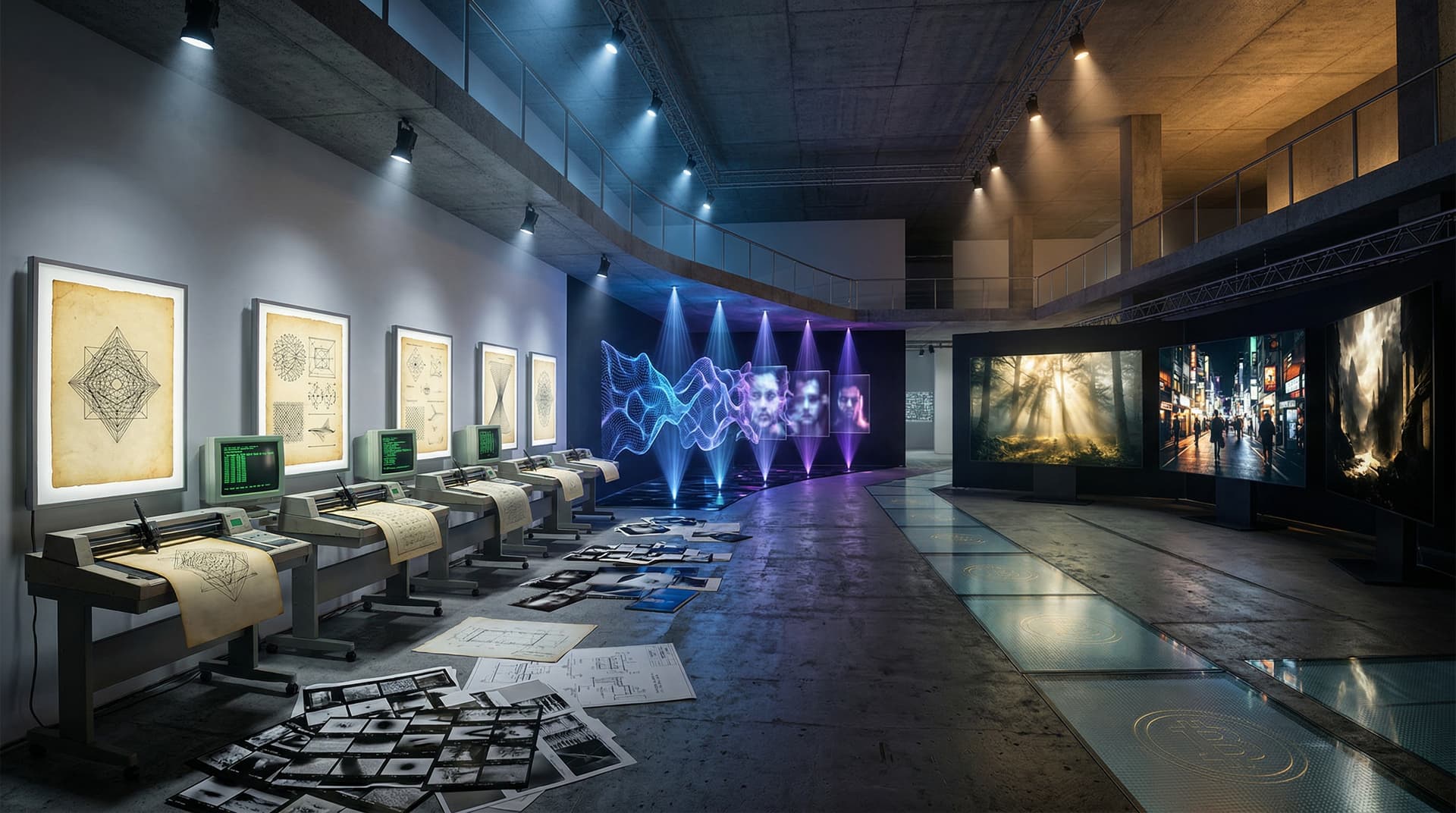
Generative art mastered AI pipelines on April 10, 2026. Diffusion models dominate production, reshaping photography workflows and visual arts markets. Neural networks generate chiaroscuro contrasts and decisive moments with precision.
Roots in Computational Creativity
Georg Nees exhibited generative plots at Stuttgart's Institute of Computational Design on February 5, 1965. Frieder Nake produced algorithmic homages to Paul Klee's color fields. A. Michael Noll simulated Seurat's pointillist brushstrokes at Bell Labs.
These ink-on-paper outputs employed radial symmetry and compressed negative space. Viewers debated machine authorship amid cybernetic precision. Early experiments paralleled analog darkroom cybernetics.
Harold Cohen debuted AARON in 1973. The system drew autonomous figures with variable line weights and hatching. Cohen refined it at Stanford through the 1990s.
AARON generated contact-sheet grids of contoured figures. Feedback loops sharpened edges and poses. These mechanics previewed deep learning's role in generative art.
GANs Ignite Neural Generation
Ian Goodfellow introduced GANs in 2014. Generators battled discriminators to produce emergent forms. Adversarial training forged synthetic artworks from noise.
Mario Klingemann's 'Memories of Passersby I' (2018) streamed oil-paint-textured portraits at London's Serpentine Gallery. Crowds observed faces dissolve and reform in real time.
Refik Anadol's 'Machine Hallucinations' (2020) projected GAN-driven data sculptures onto building facades. Volumetric light fields evoked Eggleston's saturated decisive moments.
Photographers deploy GAN style transfer on analog negatives. Film grain converts to iridescent, synthetic textures.
Generative NFT sales reached $69 million USD in 2021, per Hiscox Online Art Trade Report. Platforms stabilized volumes by 2026.
Diffusion Models Dominate Generative Art
OpenAI launched DALL-E in January 2021. Stability AI released Stable Diffusion in October 2022. Midjourney rolled out weekly model updates.
These systems denoise Gaussian latent noise into coherent images. Photographers inpaint damaged architecture or extend panoramic horizons. Lightroom plugins integrate seamless workflows.
Cory Arcangel's 2025 MoMA series applied diffusion models to glitch aesthetics. Analog film scratches melted into fluid negative space and chromatic aberrations.
Rencontres d'Arles (July 1-15, 2025; Arles, France) showcased 12 AI-generated works by nine artists including Holly Herndon. Paris Photo (November 7-10, 2025; Paris) sold 45 hybrid archival pigment prints at averages of €15,000 EUR each, per Artnet.
Adobe Firefly generated $1 billion USD in Creative Cloud revenue in Q1 2026, per Adobe earnings call.
Photography Pipelines Transformed
Photographers engineer prompts for hyper-real bokeh and shallow depth-of-field. Latent spaces simulate f/1.4 aperture effects. Seed images construct narrative sequences.
Documentary filmmakers upscale 35mm war footage scans. AI restores chiaroscuro in shadowed highlights. Authenticity debates escalate in biennials.
Street photographers produce public-space proxies. These proxies navigate EU GDPR right-to-privacy restrictions.
Film revival accelerates. Darkroom kits generated $500,000 USD in sales in 2025, per B&H Photo data. AI upscales scanned negatives to 16K resolution.
Fashion agencies slash production costs 40% with AI-generated mood boards, per McKinsey Visual Arts Report 2026.
Finance Fuels Generative Art Markets
Bitcoin traded at $72,219 USD on April 10, 2026, up 1.6% daily per CoinMarketCap. Ethereum reached $2,217.81 USD, gaining 1.9%.
OpenSea recorded $150 million USD in weekly NFT volume. Venture capital deployed $2.5 billion USD into AI art startups in Q1 2026, per CB Insights.
Leica collaborated with Midjourney on computational lens simulations for M11 cameras. Christie's auctioned AI prints at $500,000 USD averages. Blockchain certificates verified provenance.
Crypto volatility attracted fractional ownership buyers. XRP hit $1.34 USD; BNB reached $602.53 USD, fueling Binance NFT drops.
Ethical Shifts in Visual Storytelling
Getty Images sued Stability AI on February 6, 2023, citing unlicensed training data. Courts settled via licensing agreements by 2026.
Artists embed C2PA watermarks for metadata tracking. Photographers log edits back to original prompts.
AI empowers blind creators through voice-to-image tools. Exhibitions broaden inclusive visual narratives.
Tate Modern's 'AI Visions' (March 15-April 30, 2026; London) presented 25 hybrid works, featuring Refik Anadol and Caroline Crawford.
Hybrid Future for Generative Art
IBM demonstrated quantum-accelerated diffusion models on April 5, 2026, achieving 100x speedups. Photobook sales climbed 25% via AI layout tools, per NPD BookScan.
Critics assess prompt engineering as core formal craft. Artists navigate latent space compositions like traditional framing.
Magnum Photos trained 150 members on diffusion workflows while enforcing documentary ethics.
Generative art cements AI pipelines as standard. Photography enables infinite iterations. Visual arts markets thrive on verifiable hybrids.