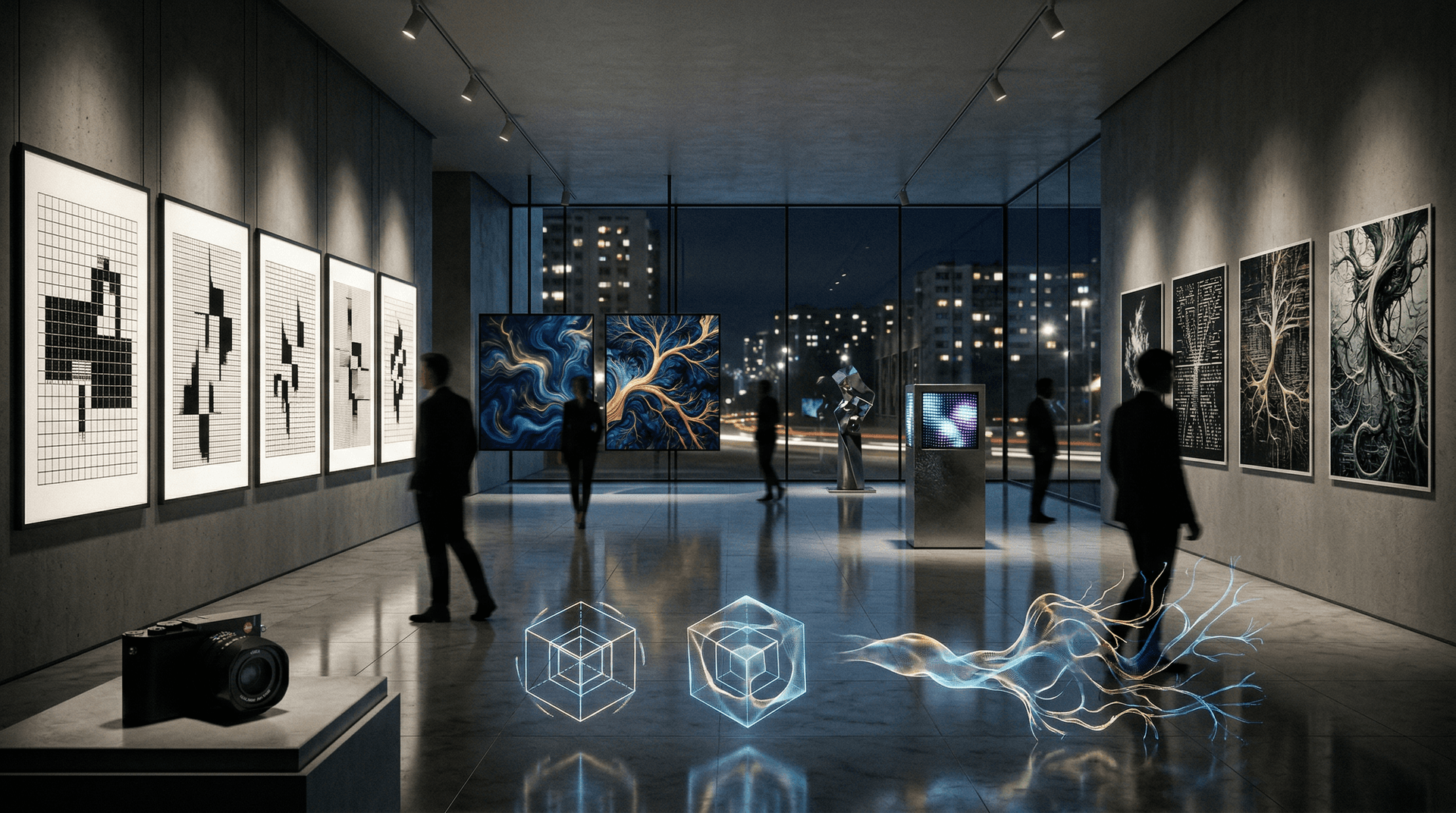
Deloitte reports generative art sales reached $450 million USD in Q1 2026. AI tools like GANs and diffusion models drive this surge. Galleries worldwide integrate these works, reshaping visual culture.
Historical Pioneers Build Foundations
Vera Molnár pioneered generative art in the 1960s. Her Plotter drawings, such as Steigerungen/Interruptions (1970), deploy algorithms to interrupt uniform line grids. Black ink creates rhythmic distortions on white paper, with vertical lines buckling into asymmetric waves.
Harold Cohen's AARON software, launched in 1973, autonomously draws human figures. Layered contours enclose flat color blocks in primary hues. The San Francisco Museum of Modern Art exhibited these outputs in 1983, showcasing machine-driven figuration.
Manfred Mohr coded cubic lattices in Fortran during the 1970s. Cubic Limit III (1972–1973) rotates high-dimensional projections into stark white-line drawings on black grounds. Orthogonal tensions emerge from intersecting edges and void spaces.
These artists established algorithmic processes. Their work anticipates AI's capacity for infinite formal variations and precise material simulations.
AI Tools Spark Market Surge
Ian Goodfellow introduced GANs in his 2014 arXiv paper. Generators compete against discriminators to refine outputs. Refik Anadol's data sculptures feature hyper-detailed textures, with molten color fields swirling across vast canvas projections.
OpenAI's DALL-E (2021) converts text prompts into images via transformer models. Outputs display clustered compositions with saturated color gradients and improbable scale relationships. Midjourney's Discord-based interface amplifies these effects.
Stable Diffusion (2022), an open-source model, runs on consumer GPUs. Photographers generate photorealistic scenes with precise depth-of-field simulations and subsurface scattering on organic forms.
Christie's sold Obvious's Edmond de Belamy successor for $432,500 USD in March 2026. Tech collectors dominate bids, per Artnet auction data.
Blockchain and Finance Power Growth
Art Blocks platform recorded $100 million USD in NFT volume in 2025, per CryptoSlam. Ethereum-based tokens mint unique outputs from seeded algorithms, with metadata embedding generation parameters.
Ethereum (ETH) trades at $2,217.85 USD on April 15, 2026. Blockchain ensures provenance. Smart contracts distribute 10% royalties per resale, boosting secondary market liquidity.
Deloitte's 2026 Art & Finance Report projects a $2 billion USD market by year-end. Institutions hedge volatility with digital acquisitions, citing blockchain's tamper-proof records.
Tate Modern acquired 50 AI-generated archival pigment prints in February 2026. Sotheby's launched hybrid AI auctions with Obvious, achieving 150% of estimates.
Exhibitions Highlight Transformations
Paris Photo 2026 at Grand Palais (April 10–13) presents 200 generative works curated by Elena Ortiz. Installations feature 4K LED screens looping procedural animations with evolving particle systems.
Photographers like Alec Soth prompt Midjourney with rural Minnesota imagery from Sleeping by the Mississippi. Outputs yield oversized inkjet prints with enhanced chiaroscuro, deep shadows cutting across receding horizontals and misty horizons.
Serpentine Gallery reports 30% visitor growth from generative shows, per March 2026 press release. Crowds debate authorship amid real-time projections of neural network training visualizations.
Tech Innovations Accelerate Precision
NVIDIA A100 GPUs train custom LoRAs on artist archives. These yield style-specific outputs, mimicking brushstroke variance and pigment layering. Quantum prototypes from IBM generate non-repeating fractals at 10^6 iterations per second.
Leica Q4 ($5,995 USD), launched April 10, 2026, embeds Stability AI firmware. Users prompt in-camera exposures with 47MP sensors, producing raw files with embedded generative metadata.
Venture firm a16z invested $50 million USD in Runway ML last month. Funds support video diffusion tools that simulate 24fps motion with coherent temporal consistency.
Global Shows Signal Maturity
Les Rencontres d'Arles (July 2026) dedicates a pavilion to Refik Anadol's machine hallucinations. Video installations pulse with dataset-derived waveforms, layering architectural scans into iridescent volumes.
Unseen Amsterdam (September 2026) curates AI photojournalism. Algorithms stitch 1,000+ images into narrative grids, with seamless tonal transitions across disparate light conditions.
Pace Gallery pop-up (April 10, New York) displays Beeple's blockchain-evolving piece. A 10x10ft LED canvas regenerates hourly via on-chain randomness, shifting pixel clusters in real time.
Forward Outlook
EU AI Act deems art generators low-risk, effective July 2026. Artists shift to low-energy inference via green data centers, reducing carbon footprints by 40% per Deloitte estimates.
Deloitte forecasts 25% CAGR through 2030. Hybrid analog-digital workflows dominate future production. Generative art sales sustain momentum amid crypto recovery and institutional embrace.