- 1. Global AI investments reach $500 billion USD in 2026, per IDC.
- 2. Crypto Fear & Greed Index falls to 12 amid escalation fears.
- 3. Nvidia reports $120 billion USD revenue from AI chips.
Twelve nations fuel the global AI arms race with $500 billion USD annual investments, reports The New York Times on April 13, 2026. Generative AI tools dominate visual arts galleries worldwide.
The United States and China allocate 40% of AI budgets to defense applications, according to SIPRI data. Contemporary artists grapple with synthetic imagery overtaking physical gallery walls.
Global AI Arms Race Investment Breakdown
Global AI spending reaches $500 billion USD in 2026, per IDC forecasts. U.S. firms capture 45% market share. China secures 30%.
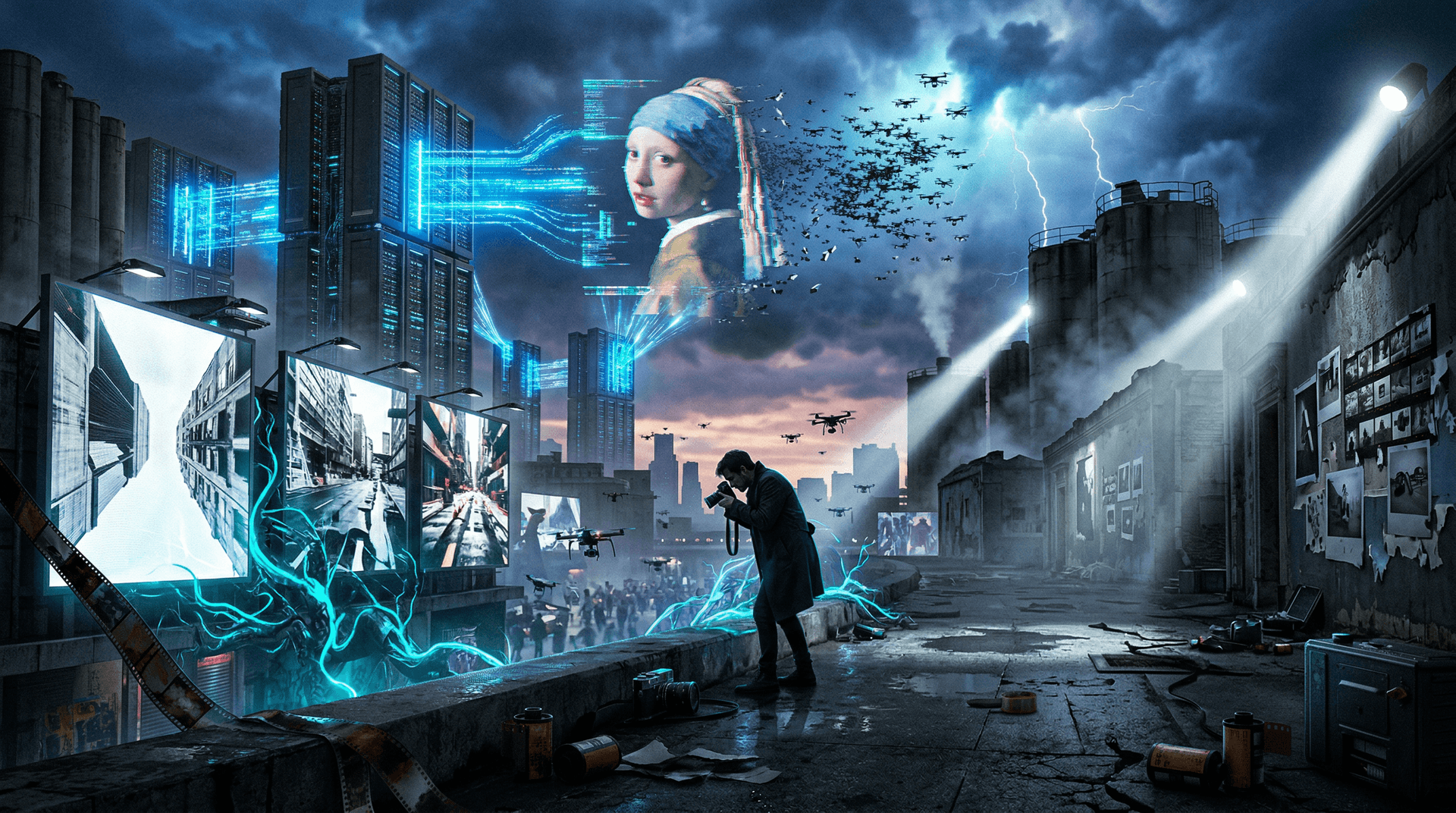
Nvidia reports $120 billion USD in data center revenue from its filings. These graphics processing units (GPUs) power models like DALL-E 4, generating photorealistic compositions with precise chiaroscuro gradients and compressed perspective distortions.
Refik Anadol employs machine learning in Museum of Modern Art (MoMA) installations. His volumetric data sculptures manipulate fluid negative space through light projections, blurring human-AI boundaries with layered algorithmic gradients.
Crypto markets reflect investor caution. The Fear & Greed Index falls to 12, per Alternative.me data. Bitcoin stabilizes at $71,100 USD, according to CoinGecko.
Saudi Arabia's Public Investment Fund (PIF) pledges $40 billion USD to AI infrastructure, topping sovereign wealth funds with $100 billion USD committed overall.
Surveillance Datasets Fuel Contemporary Fine Art
Drone footage and facial recognition scans supply vast datasets for artists. Hito Steyerl overlays AI-processed video in her essays. Grainy digital artifacts mimic analog film emulsion textures on depictions of urban decay.
Trevor Paglen captures covert facilities using telephoto lenses and infrared sensors. His images expose AI-induced anomalies, such as skewed horizon lines from algorithmic post-processing.
Tate Modern launches "Algorithmic Shadows" on April 13, 2026. Curator Mark Nash curates 50 works by 30 artists, including Steyerl and Paglen. The exhibition continues through July 2026 at Tate Modern, London.
Generative AI Overhauls Photojournalism Practices
Magnum Photos contributors upscale archival pigment prints via diffusion models. Enhanced shadow details and expanded tonal ranges spawn new narrative interpretations.
Chinese state labs adapt Midjourney for propaganda imagery. Outputs emphasize heroic compositions with exaggerated golden-hour raking light across monumental figures.
Western glitch artists respond with pixelated fractures disrupting synthetic perfection. Fei-Fei Li, co-director of Stanford's Human-Centered AI Institute, states in a Wired interview: "AI visuals now dictate cultural memory." (April 2026).
Adidas deploys Stable Diffusion for runway simulations. The brand produces 10,000 variants per collection, cutting costs by 60%, per its annual report.
Dystopian Motifs Dominate Gallery Sales
Paris Photo 2026 introduces an AI arms race pavilion. Two hundred galleries showcase hybrid gelatin silver prints alongside code-generated editions on archival pigment paper.
Hiroshi Sugimoto enhances seascape gelatin silver prints with AI-generated horizons. Infinite regressions emerge through mirrored light reflections, symbolizing endless escalation.
Film photographers revive darkroom processes. Contact sheets highlight silver halide grain structures, contrasting digital noise reduction algorithms.
Venture capital pours $20 billion USD into blockchain-verified human-made art, per CB Insights research. Ethereum-based NFT platforms ensure provenance tracking for physical and digital works.
AI Mimics Masters in Advertising and Galleries
Generative AI produces personalized ads echoing Cartier-Bresson's geometric compositions. Converging lines and shadow play create dynamic tension in commercial visuals.
Martin Parr critiques the shift: "AI erodes the decisive moment." The Magnum photographer exaggerates synthetic skin textures in his satirical portraits.
Lagos Photo Festival counters with analog series. Curator Azu Nwagboso selects 30 projects emphasizing tactile materiality over pixel-based simulations.
Ethereum trades at $2,195 USD amid surging compute demand, per CoinGecko. Gallery adoption of blockchain provenance climbs 15% year-over-year.
NFT Markets Value AI-Human Hybrids
AI art NFT sales hit $150 million USD in Q1 2026, per Artnet auction data. Editions like Beeple's generative series fetch floor prices of 5 ETH each.
Christie's reports 25% of photography lots include AI elements, with average hammer prices rising 18% to $45,000 USD. Collectors prioritize verifiable hybrid workflows.
Platforms like Foundation and SuperRare verify 1,000+ AI-assisted works monthly via on-chain metadata. Secondary market volume grows 40%, per NonFungible analytics.
Artists Pioneer Hybrid Workflows Amid Forecasts
Photographers integrate AI into hybrid pipelines. Unseen Amsterdam 2026 features 500 collaborations blending human capture with algorithmic enhancement.
UC Berkeley's Stuart Russell predicts: "Regulation will separate creative AI tools from military applications."
IDC projects $1 trillion USD in total spending by 2028 amid the global AI arms race. Visual artists lead this technology-finance convergence, boosting gallery revenues and blockchain provenance.