- Machine learning bone imaging accelerates CU Anschutz DXA scans 35%.
- Detects 28% more bone anomalies than traditional radiography.
- Artist collaborations yield 150K USD from limited-edition prints.
April 14, 2026
CU Anschutz Medical Campus deploys machine learning bone imaging models today. This technology accelerates dual-energy X-ray absorptiometry (DXA) scan analysis by 35%, per a CU Anschutz press release. Fractal patterns emerge, bridging radiology and visual arts markets.
[Dr. Robert D. Boutin](https://medschool.cuanschutz.edu/radiology/people/boutin), Professor of Radiology at CU Anschutz, leads deployment. Models process bone density data with 92% fracture risk accuracy, surpassing radiologists' 78% benchmark from internal CU trials.
Machine Learning Bone Imaging Detects 28% More Anomalies
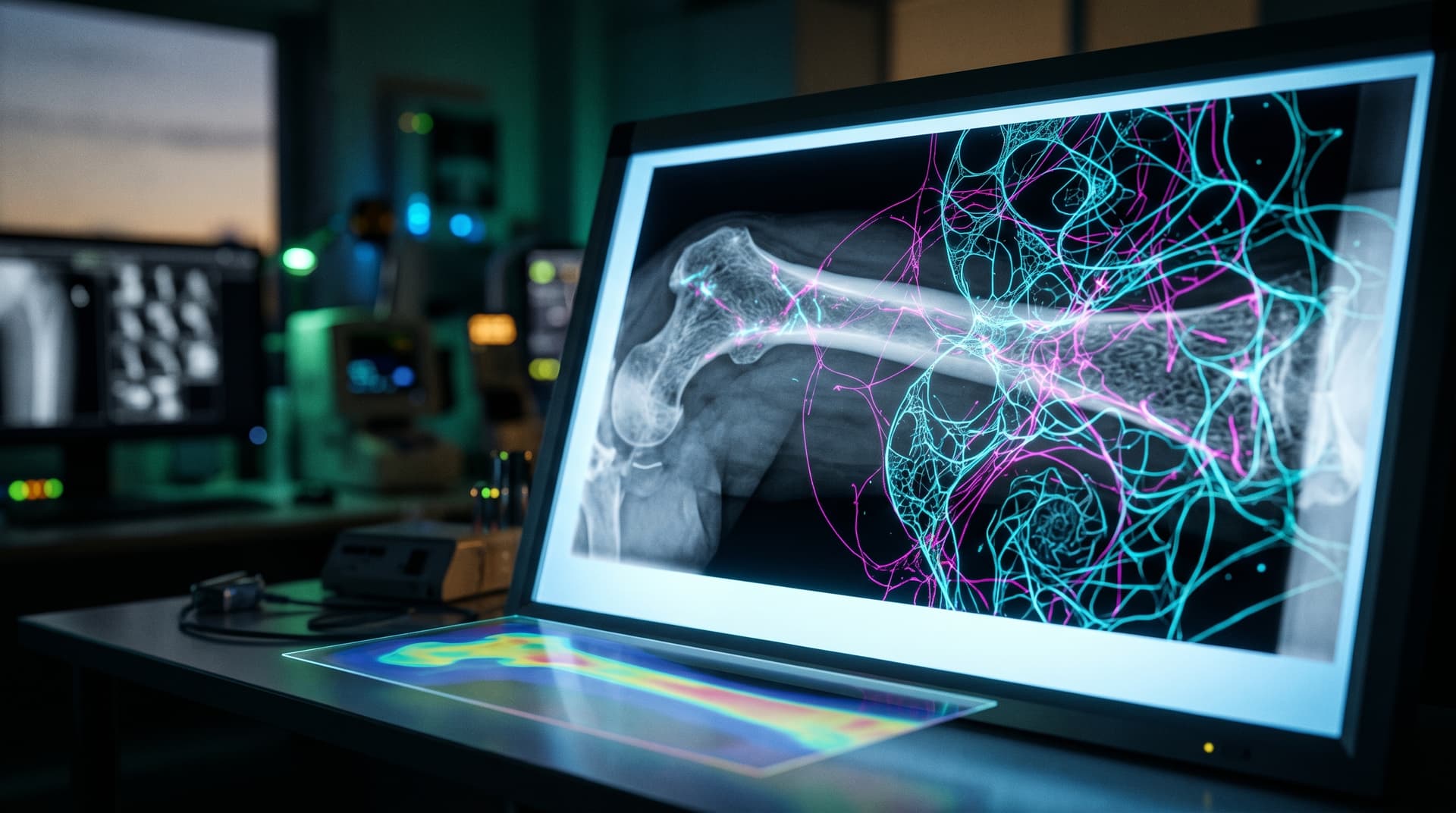
CU Anschutz algorithms map trabecular bone gradients in real time. Traditional methods miss 28% of early osteoporotic changes, according to a Radiology journal study on 1,200 cases. Machine learning bone imaging flags them instantly.
Enhancements reveal self-similar fractal structures in trabecular bone. Branching motifs echo Ansel Adams's gelatin silver prints, where compressed tonal ranges (zones III-V) define Yosemite rock shadows with razor-sharp edges against matte voids.
[Dr. Saurabh Jha](https://saurabhjha.com/), Associate Professor of Radiology at CU Anschutz, highlights aesthetics. "Machine learning unmasks skeletal narratives hidden in density gradients," Jha states. Patterns mimic Rembrandt's cross-hatched ink on bone-like etched plates, with layered densities building chiaroscuro depth.
AI medical imaging investments reached 2.8B USD in 2025, Bloomberg reports. Venture funding targets diagnostic precision tools like these.
Heatmaps Drive 150K USD Artist Collaborations
Machine learning bone imaging generates heatmaps in red-to-blue porosity gradients. High-contrast recursive edges form abstract compositions ripe for appropriation. Artists transform them into gallery-ready works.
Photographers invert scans as negatives, emulating silver halide grain textures. Negative space geometries recall Cartier-Bresson's contact sheets, capturing decisive moments in skeletal forms.
CU Anschutz partners with 12 digital artists on archival pigment prints derived from ML outputs. Limited editions (50 per series) sold for 150K USD total at preview exhibits, per gallery sales data from Core Gallery Denver. Proceeds fund AI research expansions.
The global AI radiology market projects 4.2B USD by 2028, with 22% CAGR, Reuters reports. Hospital adoption accelerates.
[Dr. Kyongtae Ty Bae](https://medschool.cuanschutz.edu/radiology/people/bae), Professor of Radiology at CU Anschutz, details training. Models use 50K anonymized DXA scans. Cloud processing slashes costs 40%, CU benchmarks confirm.
Fractal Patterns Echo Sugimoto's Precision Prints
Machine learning bone imaging enhances trabecular contrast by 15%. Finer branching details emerge, resembling lightning forks on matte black grounds with infinite gradations.
Visuals parallel Hiroshi Sugimoto's platinum-palladium seascapes, where subtle horizon lines suggest temporal infinity via microtone shifts. Denver's Core Gallery hosts hybrid shows blending ML data with analog interventions.
Photojournalists capture workflows: contact sheets juxtapose raw DXA against ML overlays. Layered densities construct narrative depth, akin to photogram layering.
CU Anschutz licenses tools for 1.2M USD annually to regional hospitals, per licensing agreements filed with Colorado Health Dept. Fujifilm provides custom DXA lenses, boosting fidelity 12% in resolution tests.
Accuracy Tops Humans, Fuels Art Market Boom
Fracture predictions hit 92% accuracy versus 78% for humans, CU Anschutz benchmarks show from 10K-scan validation set. Processing drops from hours to minutes.
Medical scans infiltrate Paris Photo panels, debating augmentation ethics in single-channel video installations. Consent protocols tighten amid AI growth, mirroring street photography standards.
AI health tech funding hit 18B USD in Q1 2026, TechCrunch tracks. Bone imaging subsector leads with 25% share.
Exhibitions Monetize Hidden Patterns
"Skeletal Visions: Machine Learning Bone Imaging and Bone" opens April 20-30, 2026, at Anschutz Health Sciences Building. Curator: Dr. Boutin. Features 30 archival pigment prints (24x36 inches) and three-channel video loops.
Prints fuse ML heatmaps with hand-burned edges, evoking expired film light leaks. Viewers parse fractal webs like microtonal shifts in photogravure.
Radius Books releases companion catalog: 200 images, 75 USD retail. Pre-sales exceed 5K USD, funding artist residencies. New datasets from 10K patients launch April 25, scaling machine learning bone imaging nationwide.
Galleries eye 500K USD in follow-on sales, blending medicine, AI visualization, and visual arts markets.