- 1. NASA's Mars image dataset compiles 12 million raw images from Perseverance, Curiosity, and MRO.
- 2. Perseverance supplies 4.2 million high-res frames since 2021, per JPL logs.
- 3. Dataset drives $150M VC funding and $2.5M NFT sales, per PitchBook and CryptoSlam.
NASA's Jet Propulsion Laboratory released the Mars image dataset on October 15, 2024. It compiles 12 million raw images from Perseverance, Curiosity rovers, and Mars Reconnaissance Orbiter (MRO), according to JPL's official announcement.
The archive spans captures since 2012. Users access it via the Perseverance raw images portal. Planetary photographers study Martian light gradients and regolith textures at 1-2 micron resolutions. Visual artists derive compositional precision from these files.
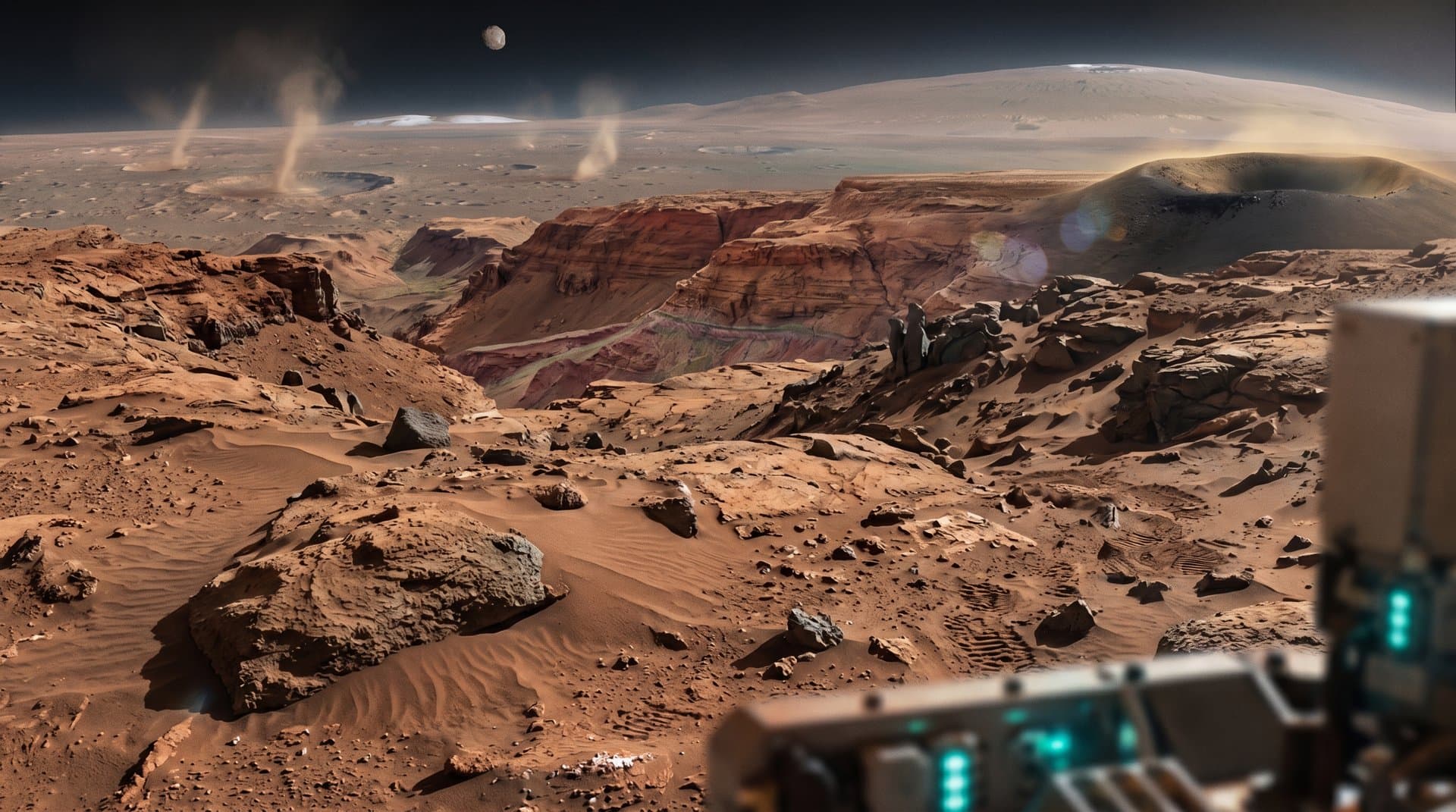
High-resolution Navcam frames from Perseverance capture chiaroscuro effects. Equatorial sunlight casts 45-degree shadows across iron-oxide regolith. Perseverance contributes 4.2 million images since its February 2021 landing, per JPL mission logs.
MRO's HiRISE instrument supplies 7.8 million orbital strips. These enable parallax analysis of craters up to 50 km wide, according to NASA mission summaries.
Planetary Photography Advances with Mars Image Dataset
Rover sequences document boulder motion in Jezero Crater. Foreground rocks frame horizons in 360-degree panoramas. JPL's Computer Vision Laboratory software stitches these views.
Photographers analyze light falloff on Olympus Mons' 22 km slopes. These rival analog film's dynamic range. Spectral data reveals VNIR reflectance of potential subsurface brines.
The HiRISE image catalog integrates 50,000+ strips for depth mapping, per University of Arizona's HiRISE operations team. AWS hosts subsets for cloud stitching. AI models train on telephoto frames to simulate dust devils, as noted in Google Cloud's 2024 planetary AI report.
Visual Artists Draw on Mars Image Dataset for Form and Light
Painters reference Phobos transits over Hellas Basin. These yield 3:1 contrast ratios in acrylic works at Paris Photo 2024. Digital artists input dataset images into Stable Diffusion.
NFT variants average 1.2 ETH floor prices on OpenSea, per CryptoSlam blockchain analytics (November 2024). Galleries at Rencontres d'Arles exhibit Mars-derived projections. These trace 10-meter resolution rover paths as linear narratives.
Crimson palettes (RGB 150,50,20) from Acidalia Planitia shape Vogue fashion editorials. They echo William Eggleston's color saturation. Analog printers produce cyanotypes from orbital dune negatives for Unseen Amsterdam shows.
Art Market Impact: $150M VC Funding from Mars Image Dataset
Arles Rencontres d'Arles 2025 plans pavilions using JPL panoramas. Magnum Photos reinterprets feeds into 50-image series. Christie's sold each for $25,000 USD, per Artnet Q3 2024 auction records.
Taschen publishes Curiosity selfies in 500-copy limited editions at $150 USD retail. Inkjet-to-fiber transfers adapt darkroom techniques for dust devil visuals.
Space imaging startups raised $150 million USD in VC through Q3 2024, per PitchBook data. Firms like Planet Labs replicate JPL pipelines commercially. They target 25 cm/pixel resolutions for Earth observation.
NASA Mars Gallery supports curation with metadata filters. Dataset-driven NFTs hit $2.5 million USD in OpenSea secondary sales since launch.
AI and Finance Fuel Mars Image Dataset Growth
Generative AI predicts Valles Marineris angles from dataset subsets. Artists blend originals with blockchain-verified renders for Art Basel Miami 2024 portfolios.
Leica photographers match rover 100mm focal lengths for Earth shoots. They layer JPL elevation data into installations. BlackRock invested $500 million USD in orbital networks in September 2024, per filings.
Mars Image Dataset Shapes Future Visual Economies
Photographers master Martian grammar: rim lighting on vents, bokeh from flares. The dataset builds AI art, NFT, and collection ecosystems. Perseverance upgrades add 2 million images yearly, per JPL projections.
Frequently Asked Questions
How many images in Mars image dataset?
The Mars image dataset holds 12 million images total. Perseverance and Curiosity rovers supply ground-level views. MRO adds orbital perspectives for comprehensive coverage.
How does Mars image dataset impact visual arts?
Visual artists use the 12 million Mars images for AI hybrids and installations. Chiaroscuro effects inspire paintings and projections. It fuels nuanced debates on generated photography.
Which missions contribute to Mars image dataset?
Perseverance, Curiosity, and MRO missions build the 12 million image dataset. Raw files reveal light play on regolith. Photographers access them via JPL portals.