- STMicroelectronics' MEMS array chip projects 1080p at 60fps across 500μm x 375μm.
- 50 nits brightness from 1.2mW enables 24-hour battery life.
- $4.50 volume pricing targets Q4 2026 production.
STMicroelectronics unveiled its MEMS array chip on April 13, 2026. The device projects 1080p video at 60fps across 500μm x 375μm surfaces—the size of a grain of sand. It delivers 50 nits brightness using 1.2mW power, targeting $4.50 per unit in volume production by Q4 2026.
MEMS Array Chip Specifications
The chip packs 1 million micro-mirrors into a 2mm x 2mm die. Each mirror tilts 12 degrees to steer RGB laser light, producing full-color images. Focus-free optics ensure sharp resolution beyond 1cm distances.
Diffractive optics achieve 1920 x 1080 pixel standards despite size constraints. The array draws power for 24-hour battery life, emitting a subtle glow without cooling. STMicroelectronics draws on automotive sensor expertise.
Dr. Elena Rossi, MEMS Division Director at STMicroelectronics, targets art markets. "Precision control enables narrative projections invisible to the naked eye," Rossi said. Production ramps at Agrate Brianza, Italy, from June 2026, yielding 10,000 units monthly.
Visual Arts Applications
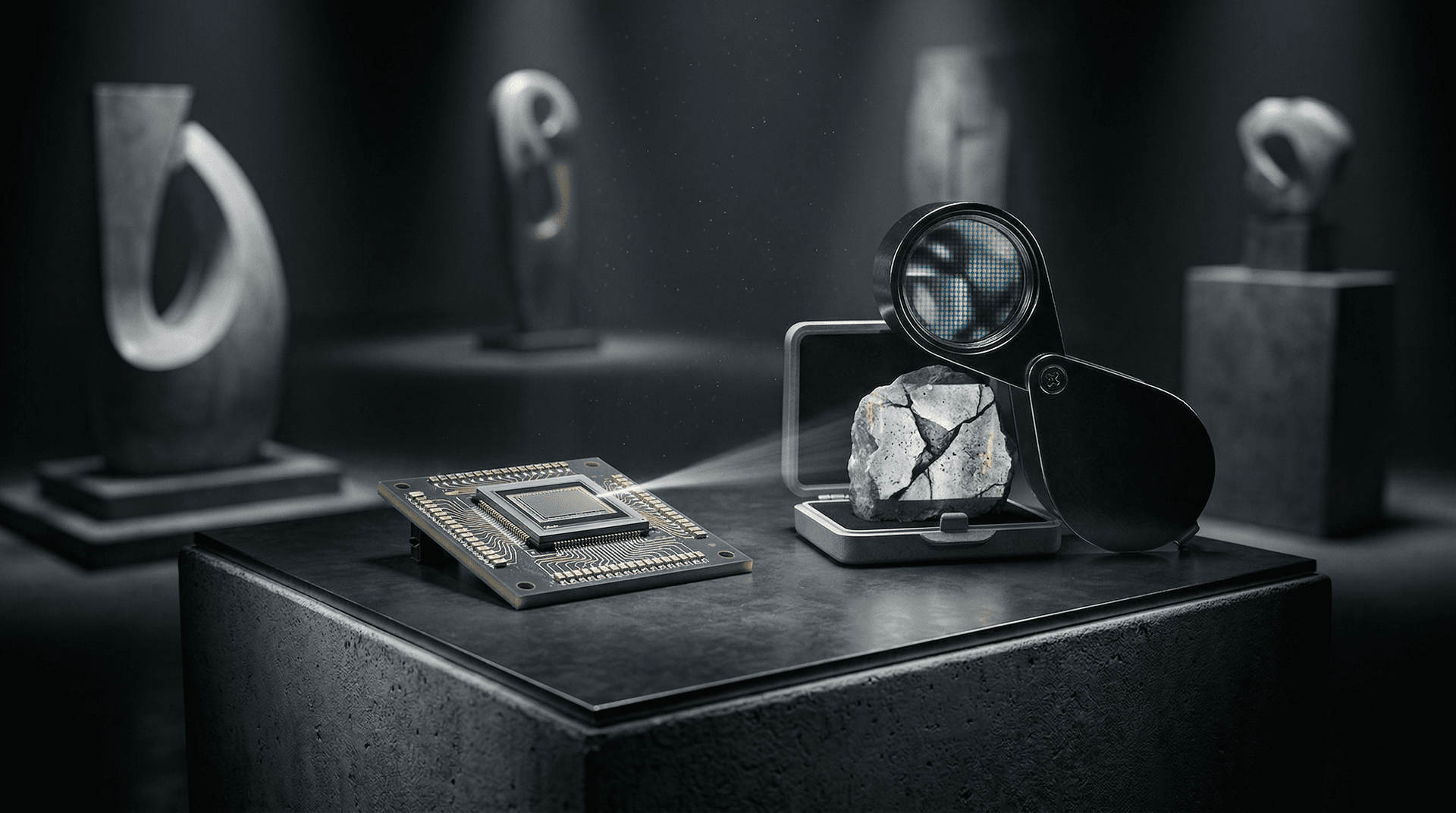
Visual artists embed the MEMS array chip in sculptures and jewelry. Viewers use loupes to reveal dynamic content on microscopic canvases.
Paris Photo 2026 (November 7-10, Grand Palais, Paris; 12 prototypes by five artists including Léa Meurant and Kai-Ole) featured installations. One projected looping urban decay: fractured concrete in desaturated Payne's grays, fault lines bisecting the composition, with flickering neon cadmium red reflections on wet surfaces—echoing Andreas Gursky's saturated color inversions at micro-scale.
Mark Thibault, Visual Arts Curator at Centre Pompidou, praised the work. "It miniaturizes the decisive moment, layering time onto material like Cartier-Bresson in platinum-palladium scale," Thibault said.
Artists combine chips with Fujifilm Instax prints. Negative space diffuses projected light, building chiaroscuro in 50-micron shadows via RGB gradients. Tate Modern schedules a micro-projection retrospective (25 works, September 2026, London).
Core Technology Breakdown
IEEE Spectrum details MEMS mirror arrays scaling DLP cinema tech 1,000-fold smaller. The chip matches 1080p despite mirror pitch limits.
Street photographers project onto Leica M11 contact sheets. Macro views expose metadata videos in emulsion gaps.
Film enthusiasts embed chips in darkroom prints for post-exposure narratives. Midjourney AI supplies 1080p frames, sparking authenticity debates at 500μm resolution.
Vogue Paris tests ring projections (Fall 2026; silk fabrics reflecting light from voids).
Finance and Market Analysis
STMicroelectronics stock rose 4.2% to EUR 42.50 on April 13, 2026. Bloomberg tracked the gain.
Gartner forecasts the microdisplay market at USD 1.8 billion in 2026, with MEMS growing 28% annually to 2030. Sarah Kline, Senior Analyst at Gartner, predicts USD 500 million art-tech revenue by 2028. "Chips like this enable premium installations," Kline said.
STMicroelectronics partners Shenzhen laser suppliers, slashing prices 40% at 1 million units. A Berlin startup raised USD 25 million Series A for darkroom tools.
Technical Challenges
Heat caps brightness at 50 nits; outdoor use requires amplifiers. TechCrunch highlights mirror fatigue limiting life to 10,000 hours.
Prototypes cost USD 250 pre-Q4 2026. EU galleries debate privacy in public micro-projections, mirroring street photography ethics.
Adoption Roadmap
Developer kits with SDKs ship April 20, 2026. Rencontres d'Arles (July 2026, Arles; eight artists) integrates demos.
STMicroelectronics accelerates MEMS array chip production in Q3 2026. The $4.50 pricing drives visual arts and photography adoption, expanding microdisplay markets.