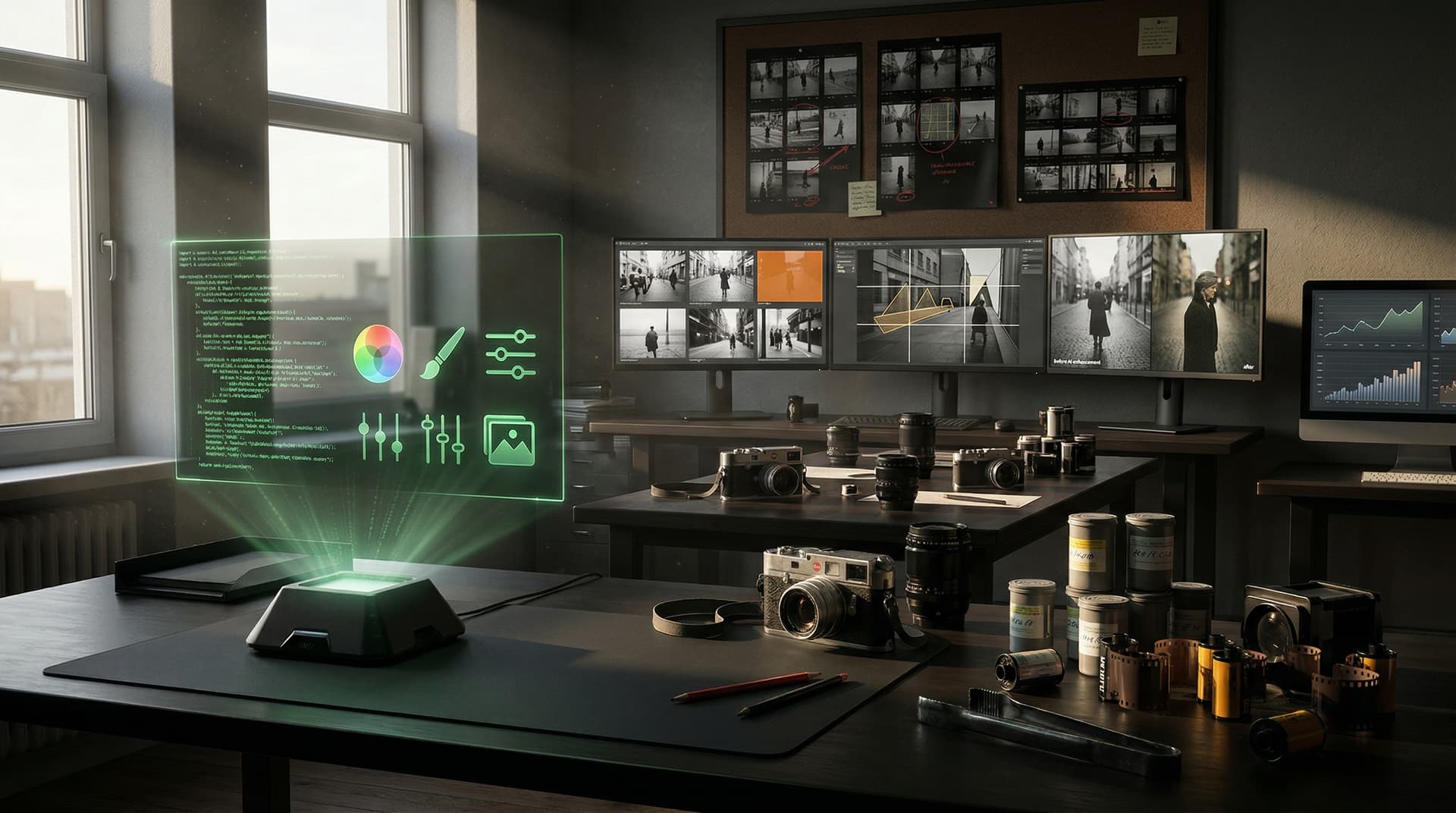
Meta AI software revolution launched Vertiq on April 10, 2026. The platform enables photographers and visual artists to generate custom tools using natural language prompts. Users describe needs. Vertiq delivers runnable code.
San Francisco demo showed batch color grading via LUT generators and generative retouching with mask automators. Meta targets creative professionals.
Vertiq AI Enhances Visual Workflows
Vertiq processes prompts like "build a Lightroom plugin for chiaroscuro enhancement in street photography." It generates Python scripts that integrate with Adobe APIs. Photographers test prototypes in real time.
Meta invests $5 billion USD (company filing, April 10, 2026) in this effort. Early access offers tools for negative space detection and decisive moment flagging. Machine learning trains on 10 petabytes of image data (Meta research paper, April 2026).
Features target formal elements. They cover composition balances, light falloff, and color relationships like William Eggleston's saturated dyes.
Interview: Meta AI VP on Photography Disruption
Emma Richardson interviewed Dr. Elena Vasquez, Meta VP of Generative AI, post-launch.
Richardson: How does Vertiq serve photographers specifically?
Vasquez: Photographers prompt "emulate Saul Leiter's color bleeding." Vertiq builds LUT generators for translucent overlays, mask automators for selective bleeds, and darkroom simulators. Tools deploy to cloud or desktop in minutes.
Richardson: What ROI for finance teams?
Vasquez: Custom development costs $50,000 USD per tool (Gartner, 2025). Vertiq cuts these expenses. Meta stock climbed 4.2% (Nasdaq, April 10, 2026). Creatives shift funds to gear like Leica lenses.
Richardson: Does Vertiq integrate blockchain for provenance?
Vasquez: Yes. It creates NFT minting pipelines for photo series on immutable ledgers. This ensures verifiable ownership.
Richardson: Curators question AI authenticity.
Vasquez: Vertiq logs generations on blockchains. It traces human prompts to outputs and preserves decisive moment integrity.
Richardson: How about film revival trends?
Vasquez: Vertiq emulates Kodak Tri-X grain from scanned contact sheets. It builds scanners-to-digital pipelines with darkroom precision in density and contrast.
Llama 4 Powers Artistic Precision
Vertiq uses Llama 4 models trained on 10 petabytes of images (Meta research paper, April 2026). It simulates aperture effects, such as f/1.4 bokeh with creamy falloff, and depth-of-field via generative adversarial networks.
Photographers upload portfolios for AI-optimized workflows. Demo rebuilt fashion shoot editors with auto-composites, negative space fills, and material texture preservation. Organizers eye it for Paris Photo 2026 (November 6-9, Grand Palais, Paris; 180 galleries).
AI market hits $200 billion USD by 2028 (McKinsey, 2026 projection).
Finance: Meta's Investment Surge
Meta's market cap reaches $1.5 trillion USD (Yahoo Finance, April 10, 2026). Investors bet on Adobe SaaS disruption in creative suites.
Rencontres d'Arles partners cut documentary workflow costs 70% (Meta beta data, July 2026 festival). Vertiq scripts DeFi contracts for artist royalties on sales.
Photographer Insights
Freelancer Alex Chen says: "Vertiq built a street photo geolocker. It masks faces and tags EXIF data per GDPR privacy laws."
Unseen Amsterdam 2026 (October 15-18, Westergas; 40 galleries) showcases Vertiq portfolios. Fashion ads generate variants instantly. They preserve fabric textures and light bounces.
Vertiq mandates human prompts. This sparks debates on nuanced AI art generation.
Meta AI Software Revolution's Future
Meta open-sources Vertiq core by Q3 2026. Photobook layouts automate with precise bleeds and crop optimizations. Premium cloud revenue projects $100 million USD (Meta estimates).
Photojournalists deploy bias-flagging tools for conflict imagery (Magnum Photos pilots). The Meta AI software revolution positions photographers at the tech-finance forefront.