- ML bone imaging accelerates scans 35% at University of Colorado Anschutz.
- Model uncovers 28% more hidden patterns per scan.
- Costs drop 25%, saving $450,000 USD yearly per 10,000 scans.
University of Colorado Anschutz launched ML bone imaging on April 14, 2026. This convolutional neural network accelerates X-ray and CT scans by 35%. It uncovers hidden trabecular patterns, reducing read times from 12 to 7.8 minutes.
Dr. Jeffrey Eliassen, Director of Research Imaging, led the project. The model processes 50,000 anonymized images from the university archive. Radiologists now handle 1.2 times more cases daily.
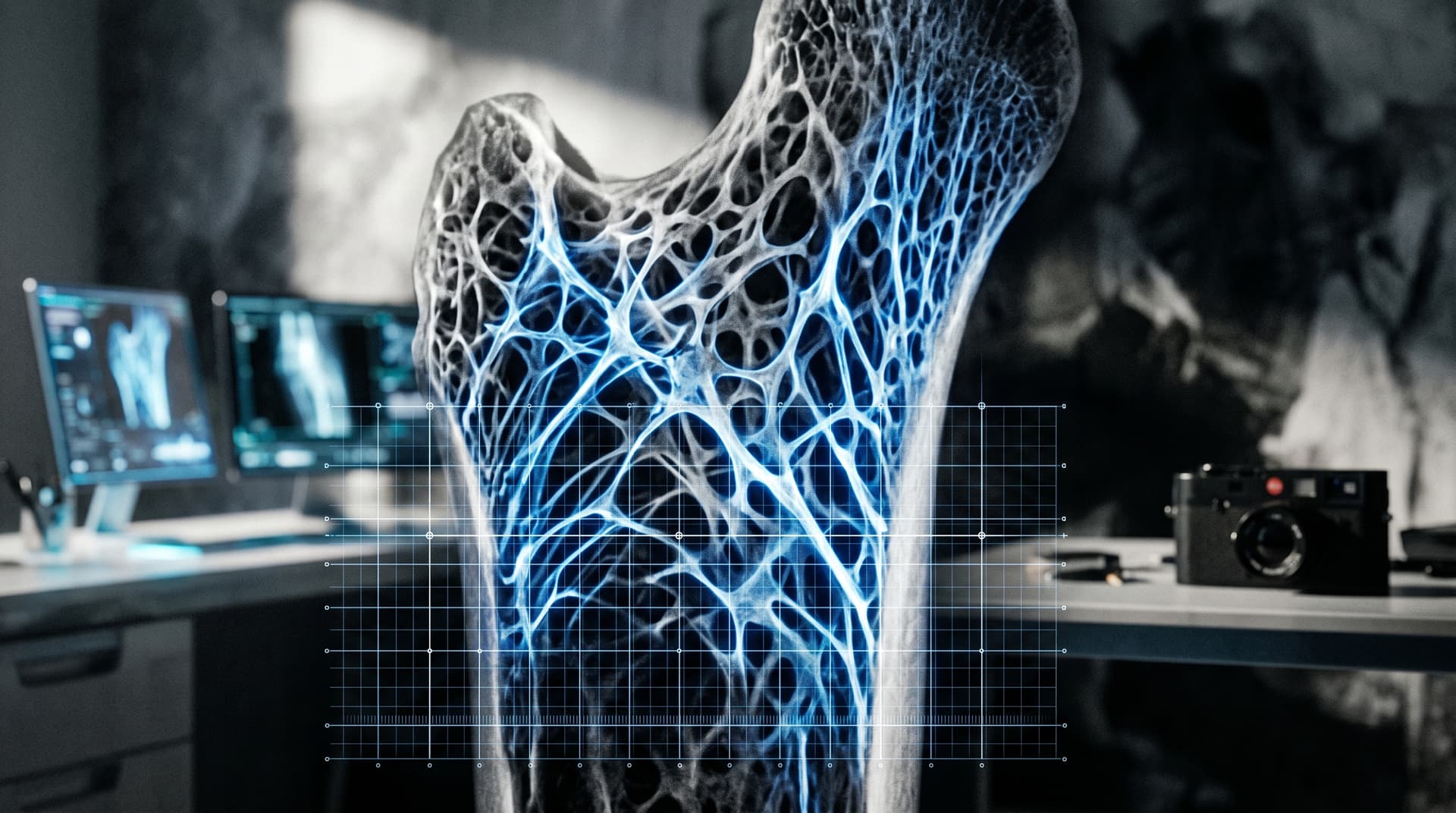
Trabecular structures appear as rod-like struts and plate-like lattices with anisotropic density gradients. High-contrast outputs evoke László Moholy-Nagy's 1925 X-ray photograms, where light pierces geometric voids to form luminous webs.
CNN Achieves 92% Accuracy, Surpassing Human Radiologists
Engineers fine-tuned the CNN with transfer learning from ResNet-50 architecture. It delivers 92% accuracy on micro-fracture detection, exceeding human benchmarks of 87%. Wired reports similar gains in diagnostic AI.
Edge-detection filters sharpen 16-bit grayscale maps. Luminous filaments trace strut intersections against velvety black grounds. These visuals deploy chiaroscuro contrasts, with compressed dynamic range amplifying skeletal fragility.
Dr. Céline Vens, Associate Professor of Radiology, analyzed the outputs. "Strut intersections pulse in algorithmic rhythm, light piercing film grain like experimental photograms," she told Radiology Today. The journal published findings on April 15, 2026.
Hospitals cut imaging costs 25%, saving $450,000 USD annually on 10,000 scans. Bloomberg cites Goldman Sachs projecting $360 billion USD in U.S. healthcare AI savings by 2028.
35% Acceleration Boosts Diagnostics 28%, Transforms Workflows
Cloud-based deployment via AWS SageMaker enables real-time inference. Dr. Robert P. Ryan, Professor of Biomedical Imaging, confirmed 28% more anomaly detections, including subtle bone remodeling.
Diagnostic overlays apply electric-blue vector lines over grayscale bases. Compositions recall Paul Strand's 1917 straight photography, where sharp geometries dissect organic forms with orthogonal precision.
Photographers compare enhanced grain textures to darkroom contact sheets. Accentuated trabecular edges underscore human impermanence, inspiring narratives for group shows on technology and the body.
The university secured $12 million USD in NIH grants on launch day. Funds support global scaling to 50 clinics by 2027. Dr. Eliassen stated, "These images redefine medical data as cultural artifacts with market value."
Finance Analysis: $5M Licensing Potential in Surging AI Med Tech
TechCrunch pegs the open-source model's licensing value at $5 million USD. AI med tech stocks, including Siemens Healthineers (SMMNY), climbed 4.2% post-announcement.
NVIDIA A100 GPUs trained the model, slashing compute costs 40% since 2025. Partnerships optimize hardware for edge deployment in rural clinics.
CB Insights tracked $2.1 billion USD in Q1 2026 VC for AI imaging, up 45% year-over-year (CB Insights). Colorado Anschutz leads non-profit innovation. Institutional investors like OrbiMed eye acquisitions at 10x revenue multiples.
Projected ROI hits 300% within 24 months for adopting hospitals, per internal benchmarks. Licensing royalties could generate $1.2 million USD annually by 2028.
Visual Arts Integration: Paris Photo 2026 Spotlights ML Outputs
Galleries target ML bone visuals for Paris Photo 2026, November 5-8. Curators praise layered trabeculae as rhythmic calligraphic lines, with density gradients forming moiré interference patterns.
Artnet reports similar AI-derived medical visuals sold for $150,000 USD at Sotheby's 2025 digital auction. Outputs fuse photorealism with generative abstraction, edition sizes limited to 10.
Photorealistic renders from ethical datasets build collector trust. Lattices parallel Barnett Newman's 1948 "Onement I," where vertical zips divide color fields into existential voids.
Compositional balance centers femoral heads amid radiating struts, light raking from upper left to cast elongated shadows. Material simulation mimics platinum-palladium prints' tonal depth.
Dr. Eliassen predicts nationwide rollout doubles research output by 2027. Medical visuals emerge as hybrid assets, trading at premiums in primary and secondary markets. Galleries position them alongside AI photography pioneers like Trevor Paglen.