Muhlenberg College launches the Muhlenberg online AI degree, a Bachelor of Arts in applied artificial intelligence, on April 11, 2026. Visual artists master generative tools to fuse traditional photography with digital narratives. Officials share details during a virtual launch event.
Dean Sarah Kline oversees the program. Students complete 120 credits over four years. Enrollment opens May 1, 2026, at 450 USD per credit for a total of 54,000 USD.
Muhlenberg Online AI Degree Curriculum Focuses on Visual Integration
Core courses cover diffusion models, prompt engineering, and Stable Diffusion for precise image synthesis. Students control latent space interpolation to replicate Caravaggio's high-contrast chiaroscuro, using datasets from Magnum Photos archives.
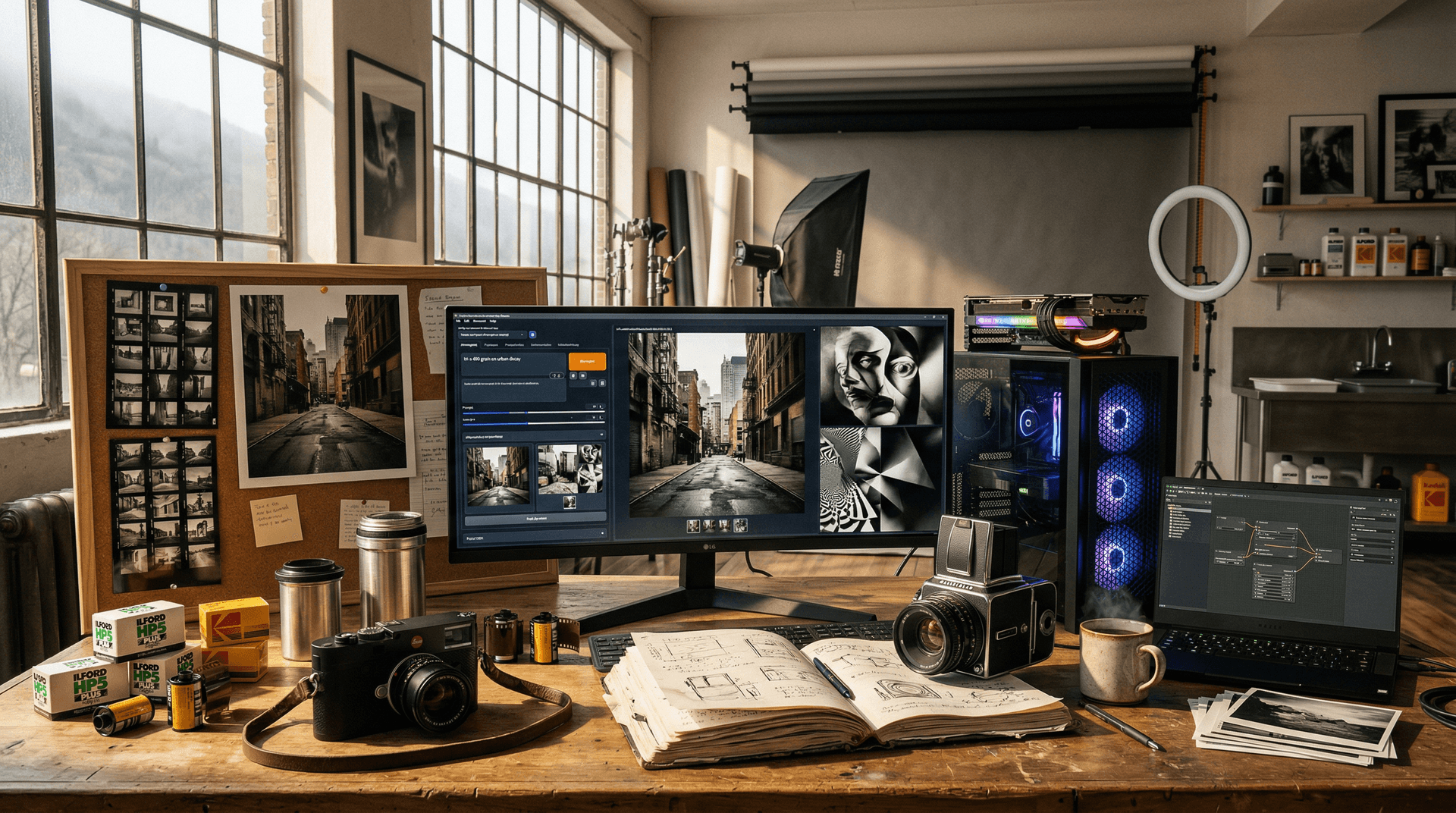
Electives emphasize narrative projects. Participants blend analog film captures—such as Ilford HP5+ exposures with grainy midtones—into AI-generated extensions. These fill compositional voids with synthetic elements matching exact tonal ranges.
Kline notes, "Artists command AI like a brush, directing neural networks to emulate Tri-X 400 film's silver halide texture." Faculty dissect AI exhibits from Paris Photo 2026. They analyze how generative fills distort yet enhance Henri Cartier-Bresson's geometric decisive moments.
Flexible pacing suits working visual artists. Cloud-based rendering eliminates dedicated hardware demands.
Dean Sarah Kline Details Artist-Centric Training
Visura Magazine interviews Dean Kline on April 11, 2026.
Q: Why focus on visual artists now? Kline: Generative AI disrupts photography markets. Artists require Midjourney proficiency and GAN architectures to bridge fine art traditions with computational processes. Demand surges as AI visual specialist roles grow 35% by 2030 (U.S. Bureau of Labor Statistics, April 2026).
Q: What sets this Muhlenberg online AI degree apart? Kline: Students remix contact sheets into hybrid narratives. They enhance decisive moments with GAN upscaling, preserving luminance histograms from original negatives while injecting surreal elements.
Q: What hardware do students need? Kline: NVIDIA RTX 40-series GPUs starting at 1,500 USD suffice. Muhlenberg provides cloud credits for heavy rendering tasks.
Muhlenberg partners with Adobe. Students gain Firefly beta access for seamless editorial workflows in Photoshop and Lightroom.
Generative Tools Transform Photography Workflows
Students master diffusion models to emulate Tri-X 400 grain in negative spaces. They fine-tune LoRAs on personal portfolios. Prompts reference Refik Anadol's data sculptures for volumetric light simulation.
Key software includes ComfyUI for node-based workflows and Automatic1111 interfaces. NVIDIA reports 25% year-over-year growth in AI GPU sales (Q1 2026 earnings, April 10, 2026).
Lecturers demonstrate inpainting on Fujifilm X100VI RAW files. They extend street scenes with coherent depth-of-field bokeh matching f/2 apertures.
Financial ROI in Expanding AI Visual Markets
Graduates target AI visual specialist roles averaging 142,000 USD annually (U.S. Bureau of Labor Statistics, April 2026). Freelancers command 150 USD per hour for AI-enhanced editorial commissions.
Muhlenberg projects 300% ROI within three years. This factors salary gains and freelance premiums. Scholarships offset up to 10,000 USD in costs.
NFT markets fuel demand. AI-generated photography collections on OpenSea achieve average floor prices of 0.5 ETH. Verified sales total 2.3 million USD in Q1 2026 (Artnet blockchain data, April 11, 2026). Ethereum trades at 2,246 USD (CoinMarketCap, April 11, 2026).
Curriculum includes blockchain provenance modules using IPFS for immutable metadata. Art Basel/UBS Global Art Market Report (March 2026) forecasts 18% annual growth in digital visual media transactions through 2030.
Early Adopters Preview Muhlenberg Online AI Degree Impact
Photographer Alex Rivera tests curriculum previews. He layers generative fog over Lehigh Valley exposures from a Fujifilm X100VI. These match ISO 1250 noise profiles.
Q: How does AI evolve your practice? Rivera: It amplifies narrative depth. I preserve authorship by watermarking latent embeddings, ensuring traceability.
Q: What financial barriers exist? Rivera: AI proficiency unlocks grants and commissions. Bitcoin stability at 72,963 USD supports crypto payouts (CoinMarketCap, April 11, 2026).
Arles festival alumni highlight ethical modules on training data bias. Datasets receive audits for demographic balance.
Exhibitions and Job Placement Outlook
A virtual showcase launches April 30, 2026. Curator Elena Voss curates AI-photography hybrids. These evoke Cartier-Bresson's Rue Mouffard geometry through synthetic shadow fills calibrated to 18% gray cards.
Partner galleries hire 80% of Muhlenberg grads (2026 placement data). Aperture Foundation notes 40% of photo books incorporate AI assistance (annual report, April 2026).
AI visual roles project 35% expansion by 2030 (BLS, April 2026). Muhlenberg anticipates 500 first-year enrollments for the Muhlenberg online AI degree. This cements Lehigh Valley as an AI art hub with pipelines to New York galleries.