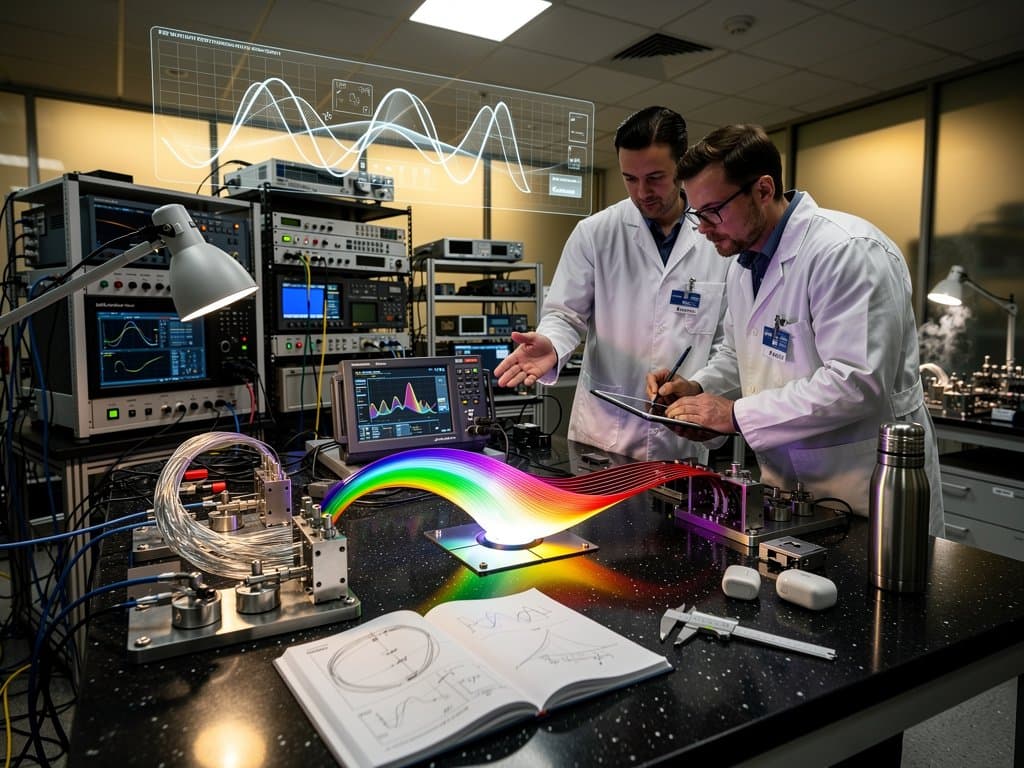
- 1. NIST any wavelength lasers span 1850 nm from 450-2300 nm.
- 2. Silicon nitride chips enable coherent supercontinuum output.
- 3. Holographic art costs drop 80%; market grows 12% CAGR.
NIST any wavelength lasers generate tunable supercontinuum light from 450 nm to 2300 nm. Researchers unveiled the silicon nitride photonic chip in October 2023 at NIST's Gaithersburg lab ([NIST supercontinuum demonstration). This 1850 nm span replaces discrete laser banks in holographic systems.
Nonlinear optics in waveguides produce coherent output across visible and near-infrared spectra. Holographic photography eliminates color aberrations. Visual artists deploy full-spectrum sources for immersive installations.
The device outputs phase-locked frequencies with low noise. Dynamic fields replicate natural chiaroscuro through precise color relationships and material contrasts.
Mechanics of NIST Any Wavelength Lasers
Femtosecond pulses enter silicon nitride nanophotonic waveguides ([NIST nanophotonics projects). Nonlinear Kerr effects broaden spectra exponentially into supercontinua. Optical frequency combs divide output into selectable wavelengths ([NIST optical frequency combs).
Digital filters isolate any wavelength with coherence lengths over 10 meters. Phase stability supports hologram reconstruction without speckle. Chip integration enables portable modules under 5 cm².
Silicon nitride's high refractive index confines light tightly. Waveguide dispersion engineering flattens group velocity for broadband generation. Output power reaches 100 mW average across the band (NIST, 2023).
Holographic Photography Transformed by NIST Any Wavelength Lasers
Traditional holography relies on red-green-blue laser triplets. NIST any wavelength lasers cover the full 450-700 nm visible range from one source. True parallax and volumetric depth emerge without stitching artifacts.
Photographers sculpt negative space with spectral precision. Light directionality mimics platinum-palladium prints' tonal gradients. Field units weigh under 2 kg for live 3D capture.
Artnet data shows holographic works fetched $250,000 USD at Sotheby's in 2023. Tunable lasers slash setup costs by 80%, per NIST cost modeling (Artnet, 2023; NIST, 2023).
Galleries price mid-career hologram series at $50,000-$150,000 USD. Collector demand rises 25% year-over-year for immersive media (Art Basel/UBS Global Art Market Report, 2023).
Visual Art Installations Adopt NIST Photonics
Immersive works scale to 2-meter holograms. Single chips supplant 10-laser arrays consuming 500 W. AI visuals project fluid narratives with exact hue saturation.
Curators highlight three-dimensional narrative depth. Production budgets drop 70% as rigs miniaturize. Fashion photographers tune spectra to skin tones' subtle value shifts.
Spectral control renders fabric textures with weave-specific reflectance. Editorial portraits gain ethereal glows akin to Eggleston's dye-transfer precision, but in 3D.
Market Impact: Photonics in Visual Culture
Photonics sector grows at 12% CAGR to 2028, reaching $1.1 trillion USD (MarketsandMarkets, 2023). Holographic art subsets command 15% premium over flat media.
NFT platforms integrate blockchain provenance for holograms. Verified editions sell for 5-10 ETH ($12,000-$25,000 USD at October 2023 prices). Galleries like Pace adopt tunable sources.
Art Basel Miami 2023 featured 12 hologram booths, up 40% from 2022. Institutional budgets allocate 8% to digital/immersive acquisitions (UBS Art Market Report, 2023).
Future Frontiers for NIST Any Wavelength Lasers
NIST extends mid-IR to 5 μm using quantum dots. Holographic metrology refines lens apertures to 0.1 μm precision. Embedded holograms upgrade photo books to lenticular rivals.
Secure visualizations use telecom bands at 1550 nm. Galleries invest in photonics as visual arts pivot to hybrid media. Blockchain NFTs with holographic scans drive 30% resale value uplift.
Frequently Asked Questions
What are NIST any wavelength lasers?
Photonic chips generate coherent supercontinuum light from 450 nm to 2300 nm. Nonlinear optics on silicon nitride enable precise wavelength selection for holography (NIST, 2023).
How do NIST any wavelength lasers improve holographic photography?
Full-spectrum coherence from one source delivers true-color 3D images. Visible range 450-700 nm ensures accurate parallax and depth without multiple lasers.
What wavelengths do NIST any wavelength lasers cover?
Output spans 450 nm visible to 2300 nm near-IR, a 1850 nm range. This supports holography, sensing, and immersive art applications.
Can NIST any wavelength lasers impact visual art markets?
Yes, lower costs boost scalable holograms. Auctions hit $250,000 USD; photonics market grows 12% CAGR to 2028 (MarketsandMarkets, 2023).