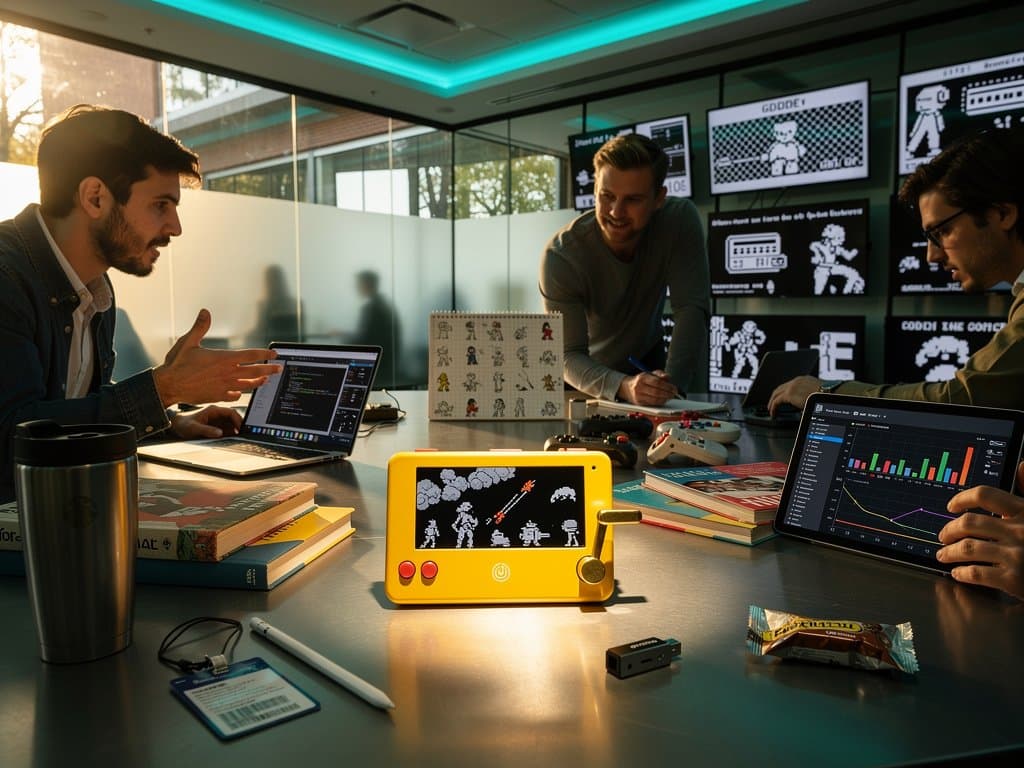
- Duke GDDI deploys 50 Playdate handhelds worth $10K since Fall 2024.
- 1-bit display hones dithering, contrast for visual arts skills.
- 2,000 community games accelerate iteration in education.
Duke University’s Masters in Game Design, Development, and Innovation (GDDI) program equips over 50 students with Playdate handheld devices since Fall 2024. Panic designs the $199 USD device with a 1-bit 180x240 pixel monochrome LCD and analog crank. GDDI Executive Director Ernesto Escobar credits it for rapid iteration cycles.
Panic's news site confirms Duke purchased the units to replace complex engines like Unreal in introductory courses.
Playdate Replaces Unreal Engine in Duke Curriculum
Playdate delivers pocketable hardware for instant playtesting. Escobar states, “The Playdate is so small and it looks so friendly,” easing peer feedback at Duke's food court. Students prototype mechanics without PC setups.
GDDI meets booming game design demand, projected at 10% annual growth per U.S. Bureau of Labor Statistics (2023 report). Playdate fuses visual arts through 1-bit constraints. Creators master negative space, silhouette edges, and dithering gradients—Floyd-Steinberg algorithms simulate chiaroscuro light in fine art photography.
Duke's investment hits $9,950 USD (50 units at $199 each, per Panic pricing), undercutting typical ed-tech budgets over $50,000 USD annually.
1-Bit Display Sharpens Visual Storytelling Precision
Playdate’s 1-bit screen demands pixel-level choices on contrast and form. Each 43,200-pixel frame conveys narrative via binary states, echoing Henri Cartier-Bresson’s decisive moment where shadow defines gesture in gelatin silver prints.
GDDI student Diego Medina Molina integrates the crank for turret aiming in his prototype. “I was inspired by the crank being able to actually aim the turret, and that was really fun,” Molina says. Dithered patterns evoke smoke trails and depth, mimicking film grain in darkroom processes.
Escobar adds, “It’s really easy to just go to the food court and say, ‘Hey, can you play my game?’” This prioritizes visual literacy over photorealism. Panic launched Playdate in 2022; Duke adopted it by Fall 2024.
Technical Specs Fuel Pedagogical and Market Value
Playdate runs an ARM Cortex-M7 processor at 120 MHz with 16MB flash storage (Panic specs, 2024). Developers use Lua-based SDK for quick compiles. The crank's 1024-position encoder enables precise analog input for visual panning effects.
Constraints spark innovation. Escobar explains: “Because of the simplicity of the tools and the portability; because of the constraints; it allows for this iterative loop to be very quick.” Students skip Unreal's steep curve, targeting core visuals.
The catalog hosts nearly 2,000 games (play.date catalog), from abstract dithered environments to narrative simulations. This library rivals NFT marketplaces in edition variety, sans blockchain.
Artist Brandon Huffman, an Army veteran and Playdate contributor, notes: “What blew me away was how intuitive the development kit] is.” His works deploy ordered dithering for metallic textures, transferable to gallery inkjet prints.
Constraints Elevate Visual Arts in Game Education
Duke students treat Playdate as a digital sketchbook. The crank crafts tactile narratives, akin to slow pans in experimental film. Composition balances high-contrast figures against void space, sharpening curatorial skills.
Over 50 devices scale labs. Community titles inspire: pixelated chiaroscuro parallels William Kentridge’s charcoal animations. Playdate counters AI overgeneration, stressing deliberate craft amid $4.5 billion USD generative art market (Art Basel/UBS 2024 report).
Play.date developers page offers free SDK downloads. Future GDDI modules blend photojournalism composition with games—1-bit negatives mirror platinum-palladium prints.
Investment Signals Ed-Tech Visual Pedagogy Boom
Panic, founded 1997, eyes education after shipping 50,000+ units (company estimates, 2024). Duke's move validates $200 million USD ed-games sector (Newzoo Global Games Market Report 2024).
Students assemble portfolios for Annapurna Interactive or IndieCade. GDDI expands visual modules, pairing AR glasses with 1-bit foundations. Playdate cements human-centered design in AI-heavy curricula.
Frequently Asked Questions
How has the Playdate handheld changed Duke University game design teaching?
Duke's GDDI program integrates over 50 Playdate units since Fall 2024. Constraints enable quick iteration. Ernesto Escobar credits simplicity and portability for rapid prototyping.
What visual arts benefits does Playdate handheld offer in pedagogy?
The 1-bit display hones contrast and negative space skills. Students create dithered narratives akin to monochrome photography. It inspires nearly 2,000 community games for study.
Why choose Playdate over Unreal Engine in Duke GDDI courses?
Playdate offers intuitive tools for beginners. Its crank adds unique input for visual mechanics. GDDI executive director Escobar notes faster feedback loops than complex engines.
When did Playdate launch and enter education?
Panic launched Playdate in 2022. Duke adopted it for introductory courses in Fall 2024. Over 50 devices now support student projects.