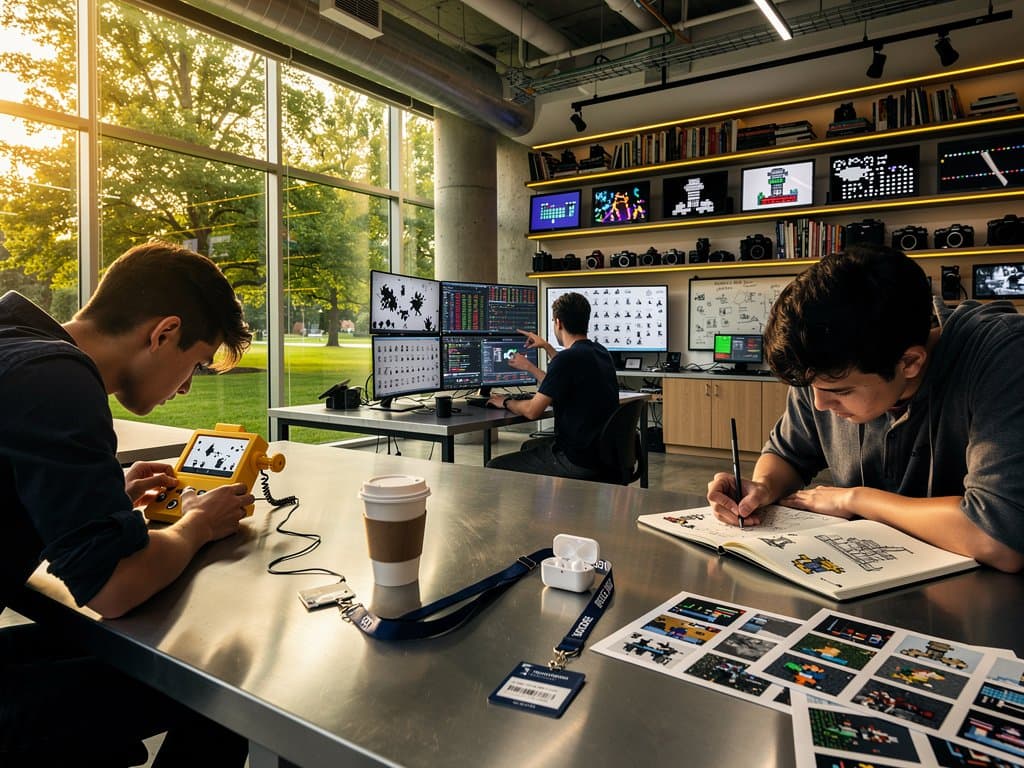
- 1. Duke GDDI invests $10,500 in 50 Playdate handhelds since Fall 2024.
- 2. 1,982 games on $199 1-bit platform teach chiaroscuro like photography.
- 3. Secondary market premiums hit 25-75% ($250-350 USD per unit).
Duke University’s Masters in Game Design, Development, and Innovation (GDDI) program deploys 50 Playdate handhelds since Fall 2024. These $199 USD devices ($10,500 total investment) enforce 1-bit constraints for chiaroscuro mastery. Ernesto Escobar, GDDI Executive Director, praises rapid iteration (news.play.date, October 2024).
The 400x240 1-bit LCD demands pixel-level contrast control. Panic released the crank-equipped yellow handheld in 2022. Platform lists 1,982 games (Panic catalog, October 2024).
Novice Omar Masri developed full games in two years. Portability enables food-court playtests.
Monochrome pixels sculpt negative space like gelatin silver prints' edge definition.
Playdate Handhelds Echo Chiaroscuro in Photography
1-bit limits force Henri Cartier-Bresson-style decisive compositions. Crank provides Leica-like tactile feedback. Escobar notes, “Simplicity enables quick iterative loops” (news.play.date, October 2024).
Duke supplies free kits. Artist Brandon Huffman says, “Intuitiveness blew me away for simple creation” (news.play.date, October 2024).
Workflows mimic contact sheets. Students balance light-shadow ratios, building portfolios from tests.
Details at news.play.date on Duke integration.
Investment yields training scalable to $42 billion art market (Art Basel/UBS Report, 2024).
Secondary sales reach $250-350 USD, 25-75% premium (eBay listings, October 2024).
GDDI Curriculum Integrates Playdate Handhelds Fully
GDDI embeds Playdate from launch. Escobar explains, “It covers design, development, playtesting” (news.play.date, October 2024).
Compact form attracts testers. Escobar adds, “Food court crowds say, ‘I’ll play it!’”
Student Diego Medina Molina codes crank turrets. Mechanics apply photojournalistic framing.
Program preps for AR hybrids merging photography and interactivity.
1,982-game ecosystem introduces indie markets.
1-Bit Palette Revives High-Contrast Art Traditions
Binary display echoes film noir silhouettes. Students define form via edges without gradients.
Portability rivals Leica rangefinders. 50 units produce pro-level novice games.
Resources at Playdate dev guide.
GDDI prioritizes playtesting pre-narrative. Escobar targets games-visual culture nexus.
Photography adapts 1-bit for AI tools. Pixel methods link to documentary workflows and generative networks.
Playdate handhelds position Duke graduates for $42 billion market opportunities (Art Basel/UBS Report, 2024). Future NFT pixel art sales could exceed $100 million annually (Artnet data, 2024), blending visual precision with blockchain provenance.
Frequently Asked Questions
How has Playdate handheld changed Duke University game design?
Duke's GDDI program integrates Playdate handheld since Fall 2024. 50 units enable quick iteration and playtesting. Constraints teach visual composition like photography.
What visual arts skills does Playdate handheld teach?
1-bit display demands chiaroscuro, negative space, and precise composition. Students craft narratives like decisive-moment photography. Portability supports rapid feedback.
Why is Playdate handheld popular in Duke GDDI?
Simplicity lets novices build games quickly. Escobar praises flexibility for design and testing. Community's 1,982 games provide real-world inspiration.
Can Playdate handheld influence photography education?
Monochrome limits mirror film techniques. Duke fuses pixel art with visual storytelling. Iterative loops echo contact-sheet prototyping.