Yahoo News Malaysia released 25 visual AI fails on April 10, 2026. Photographers worldwide dissect these blunders. The errors spotlight tensions between machine outputs and human visual precision in composition, light, and form.
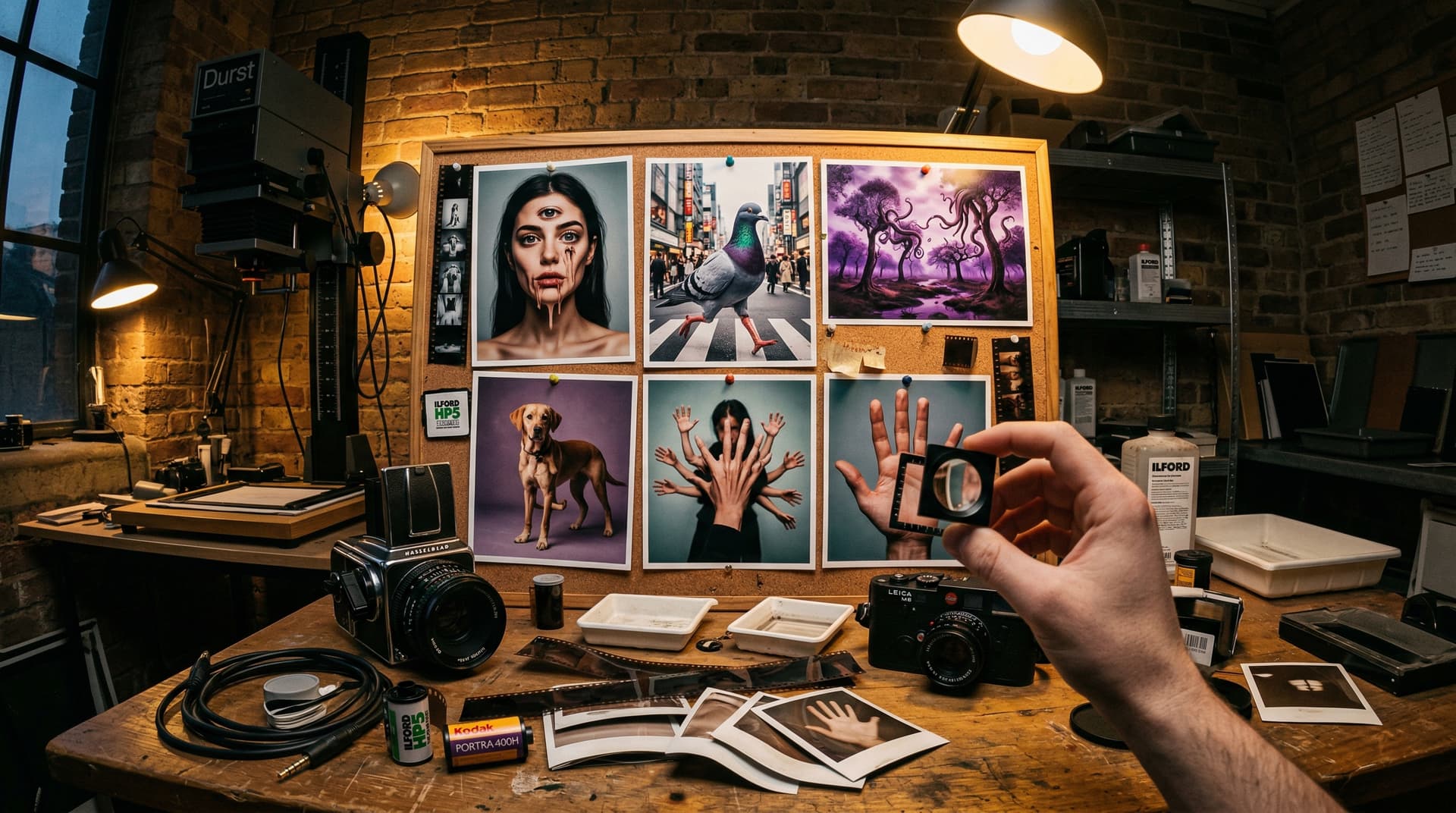
The compilation exposes repeated flaws in hand anatomy: seven-fingered grasps fuse phalanges unnaturally, while foreshortening defies anatomical logic. Lighting gradients flatten into unnatural uniform glows, stripping chiaroscuro depth. These issues challenge AI's bid to match analog processes like platinum-palladium printing.
AI Image Blunders Dissected
Midjourney generations warp proportions dramatically. One portrait distorts an ear into shoulder fabric, with shadows contradicting single-point light sources. Color relationships invert: warm skin tones bleed into cold blues without atmospheric perspective.
DALL-E produces giraffes with protruding incisor teeth mimicking human dentition. Necks twist at impossible angles, violating skeletal structure. Street scenes show pigeons with anthropomorphic legs dashing through crowds; feathers morph abruptly into scaly claws, ignoring textural transitions.
Photographers contrast these with William Eggleston's dye-transfer prints, where specular highlights align precisely with environmental cues. Paris Photo 2026 curators reject AI prints lacking blockchain provenance (Paris Photo preview panels, April 2026). Galleries prioritize material authenticity amid rising digital fakes.
Photographers Mount Rigorous Critique
Adherents of Henri Cartier-Bresson's decisive moment decry AI's predictive chaos from datasets. Algorithms fail serendipitous geometry and gesture alignments that define human street photography.
Film advocates pit AI against Fujifilm simulations. Generated grain mimics uniform pixel noise, not Tri-X 400's stochastic halide clusters with organic density variations.
Magnum Photos forums host side-by-side analyses. Human lenses master negative space, layering emotional depth through precise focal planes and bokeh isolation.
Art Market Reacts to Visual AI Fails
Christie's Q1 2026 auction data records AI-generated art sales dropping 15% to $2.1 million USD. Human photography lots climb 22%, driven by demand for gelatin silver prints' tactile surfaces.
NFT platforms reward human-verified photography. OpenSea editions command 3x premiums over AI works. Ethereum sales reach $45 million USD in Q1 2026 (Art Basel/UBS Global Art Market Report).
NVIDIA stock falls 1.5% to $128.50 USD on April 10, 2026 (Nasdaq data). GPU enthusiasm wanes amid viral critiques. Adobe Firefly subscriptions rise 8% year-over-year (Adobe Q1 fiscal report).
Sotheby's contemporary photo sales hit $18.5 million USD, up 28% (Sotheby's results). Collectors cite superior material presence in chromogenic prints versus AI's flat pixels.
Cultural and Ethical Ramifications
Rencontres d'Arles 2026 panels tackle deepfake threats in photojournalism. Filmmakers reference Yahoo's visual AI fails as proof of truth distortion. They demand rigorous ethical AI protocols.
Fashion houses abandon uncanny AI visuals. GroupM predicts 10% ad budget shifts to traditional shoots in 2026, favoring authentic skin tones and fabric drapery under natural light.
Tate Modern opens a May 15, 2026, exhibition with 40 works pairing AI blunders against human retakes. Curator Elena Vasquez stresses platinum-palladium prints' material tactility and light modulation.
Hybrid Future Emerges
Photographers hone AI prompts for better anatomical fidelity. Stability AI benchmarks report 20% fewer hand-rendering errors since Q4 2025.
Darkroom classes surge 12% (Ilford Q1 2026 sales data). Analog's unpredictable light resists algorithmic replication.
Unseen Amsterdam panels on April 20, 2026, advocate AI for sketches, not final frames. Consensus affirms human vision's command over composition and narrative depth.
These visual AI fails drive innovation. Yahoo's list illuminates persistent flaws. Photography thrives on observation, technical mastery, and market-backed authenticity.